










Data Centers


When Downtime Isn't an Option, Access Matters
One wrong move in a rack room costs more than the equipment. Ballymore's access solutions are built around the unique constraints of data center environments, including tight aisles, raised floors, and zero tolerance for disruption
Ballymore Family of Brands
Data Centers
Safe, engineered access for raised floors, dense rack rows, and the strict uptime requirements of modern data center operations.

Challenges & Solutions

01
Safe mid-rack access in narrow server aisles
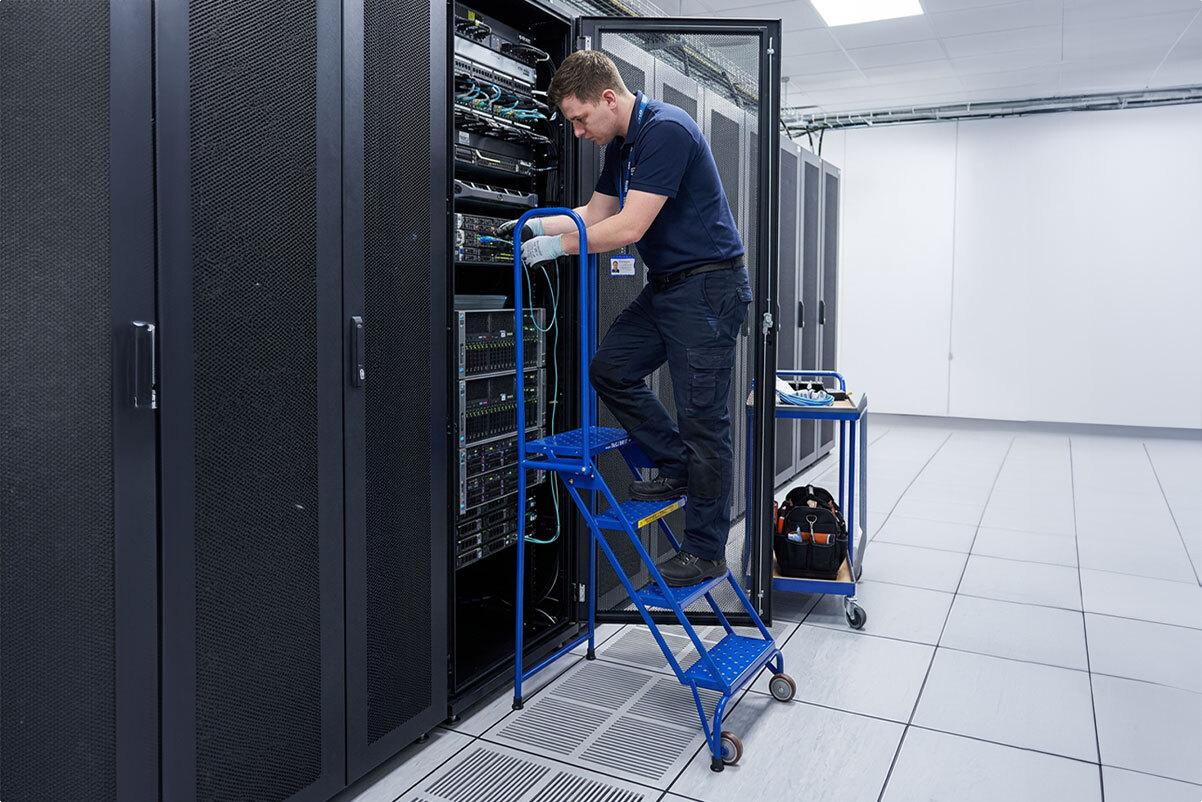
Working mid-rack sections requires a ladder that is light enough to maneuver in tight aisles but strong enough to work from safely.
02
Moving heavy IT equipment through tight aisles
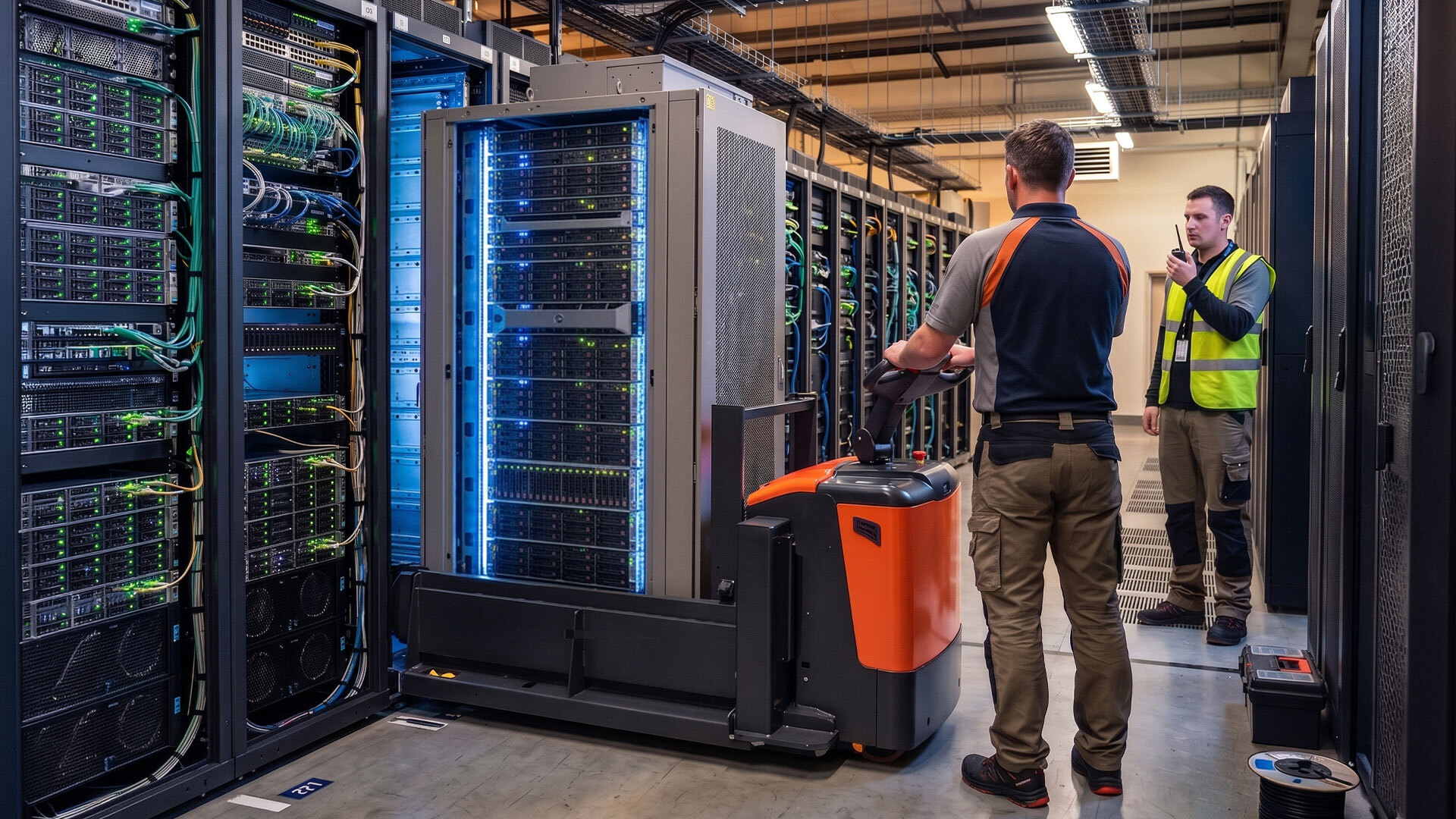
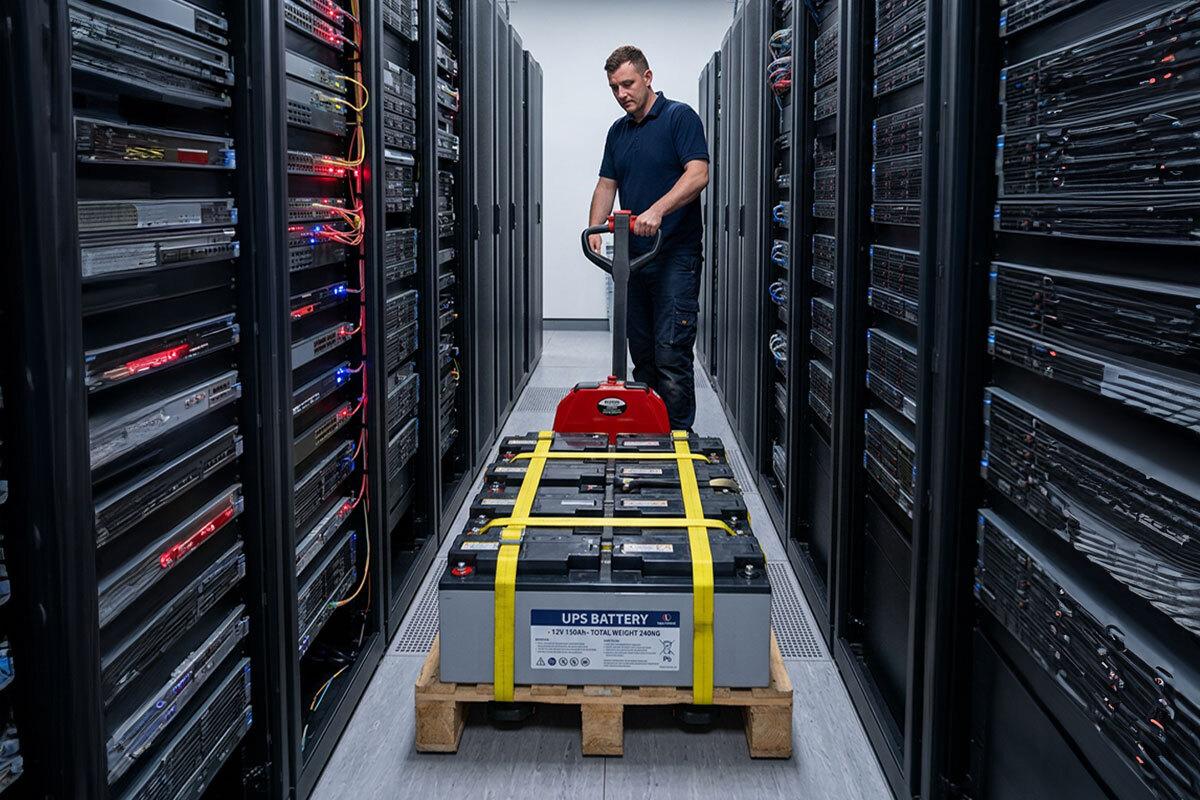
UPS batteries, server racks, and cooling components are too heavy to move manually and too valuable to risk damaging in a narrow aisle.
03
No ergonomic workstation at rack level
Techs staging tools and components at rack height need a stable, portable surface instead of improvising with floor space or rack shelves.
04
Overhead access in tight, equipment-dense aisles
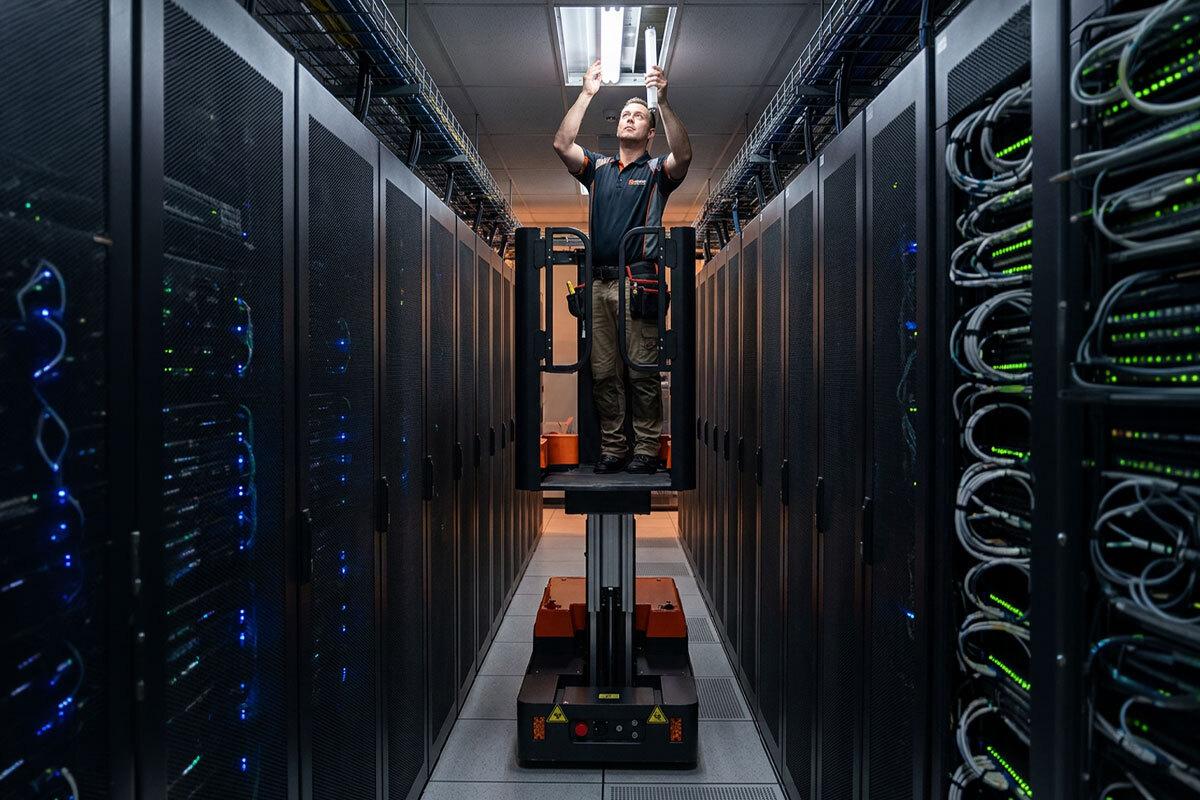
Cable trays, lighting, HVAC, and fire suppression systems all require elevated access in spaces where a standard lift cannot fit.
Lock-N-Stock Ladder in data center
Ballymore Safety Products
Lock-N-Stock Ladder
A folding ladder built for data center rack access. Folds to 10 inches deep for compact storage between uses, 350 lb rated, 58-degree slope with 7-inch steps. Locks in both folded and open positions so it stays where you put it whether it is being stored or climbed.
View Product
Powered Pallet Jack in data center
Ballymore Safety Products
Powered Pallet Jack
Moves UPS batteries, server racks, and dense IT equipment through tight data center aisles without manual handling. Eliminates the injury risk and equipment damage that comes with pushing heavy loads by hand.
View Product
Maxx-Mini-Lift Table in data center
Lift Products
Maxx-Mini-Lift Table
A compact electric lift cart that raises tools and components to rack-level working height. Keeps work organized at the right elevation and eliminates the improvised surfaces techs typically fall back on during maintenance.
View Product
Ballymore LIAM order picker in data center
Ballymore Safety Products
Ballymore LIAM
A compact, self-propelled order picker built for tight data center aisles where standard lifts cannot fit. Provides stable elevated access for overhead cable tray work, lighting, HVAC, and fire suppression maintenance without disrupting adjacent equipment or containment systems.
View Product

Common Use Cases

01
Hyperscale Campus Operations
Large-scale data center campuses require access and material handling equipment that performs the same way across every hall, building, and shift. Standardized equipment reduces training overhead and keeps operations consistent at scale.
02
Colocation Rack Maintenance
Colo technicians service multiple tenants across the same floor. They need access equipment that repositions quickly between rack rows without disrupting adjacent live equipment or other tenants' operations.
03
Enterprise Server Room Access
In-house IT and facilities teams need OSHA-compliant access equipment that works safely on raised access floors without disrupting day-to-day operations or requiring the floor to come down for every maintenance task.
04
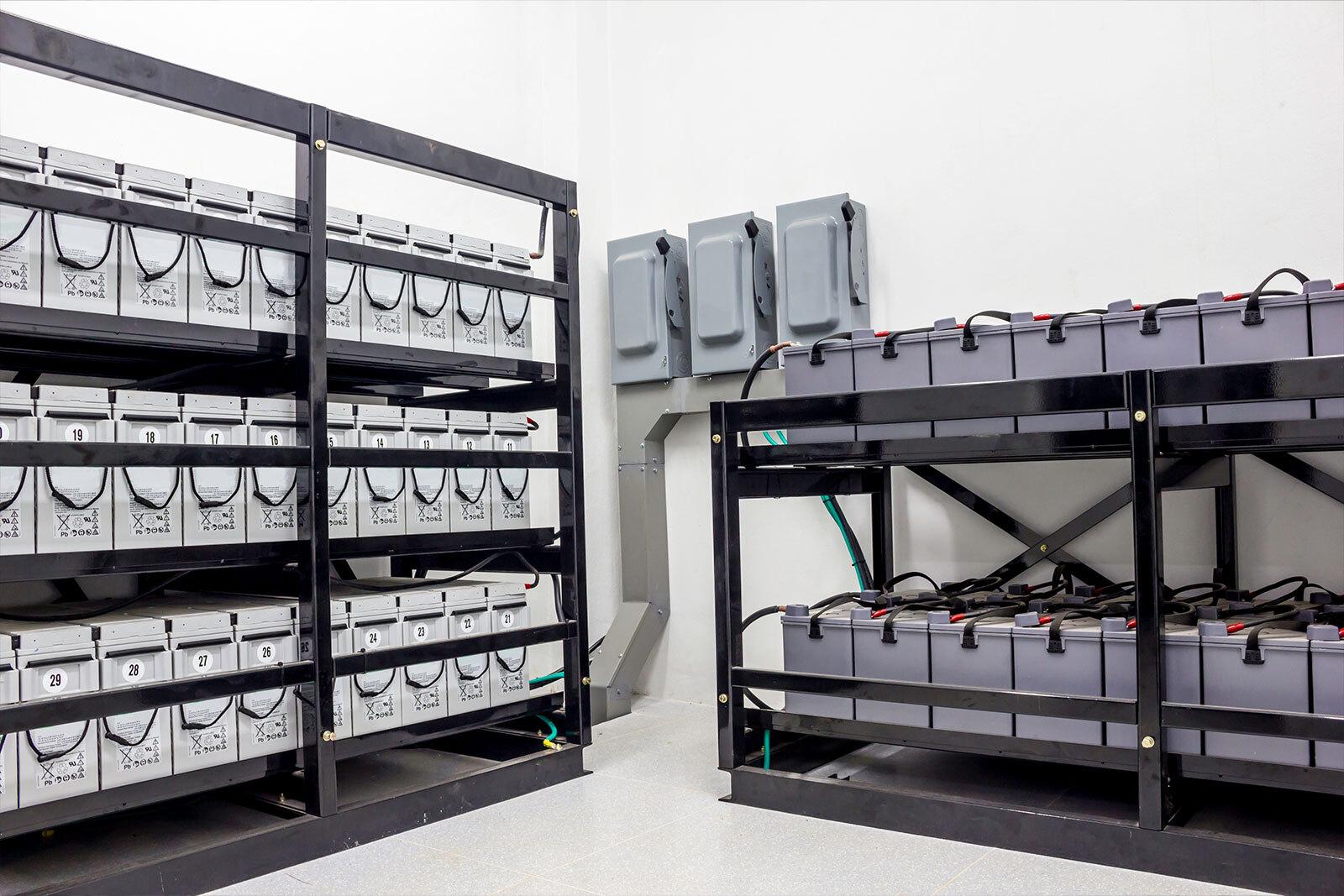
UPS & Battery Infrastructure
UPS battery replacements involve moving heavy loads through tight mechanical corridors on a set maintenance schedule. Powered handling equipment keeps the job on time and keeps the crew safe.
05
Cooling & Overhead Infrastructure
CRAC units, overhead cable trays, and fire suppression systems require periodic maintenance access in hot-aisle environments. The equipment has to fit the aisle and not compromise airflow containment while the work is being done.
06
Data Center Construction & Fit-Out
Active fit-out phases require portable, fast-repositioning access for overhead cable tray installation, mechanical rough-in, and raised floor work. Equipment needs to move with the job, not wait for permanent solutions to be installed.
Built for the Data Center Floor
What facilities operators and EHS teams gain, and the equipment behind it.
Uptime
Protect Live Equipment
A populated rack never gets muscled into place next to live gear, so a routine job does not become an incident. The right access equipment keeps maintenance predictable and downtime off the schedule.
Server & Rack Lift
Speed to Deployment
Compress the Schedule
An existing lift that fits most racks with little to no modification, and ships fast so capacity moves now. Shorter lead times mean fit-out timelines stay on track regardless of facility size.
Existing Lift + Fast Ship
Safety
Personnel and Equipment
AI servers now regularly exceed 300 lbs. Powered lifts, pallet jacks, and stackers take that load off people's hands and keep both personnel and equipment protected during installation and maintenance.
Powered Lifts, Jacks & Stackers
Security
Control Who Operates
Access control built directly into the equipment. BallyQ software, keypad entry, and physical key locks restrict operation to authorized personnel, a critical requirement in high-security data center environments.
BallyQ, Keypad & Key Locks
Productivity
Do More With Fewer Hands
Powered equipment lets one worker move and place loads that used to take a crew, so the same team covers more racks, more floors, and more shifts without adding headcount.
Powered Jacks, Stackers & Tugs
Customization
Built to Your Need
When a standard unit does not fit the application, Ballymore's in-house engineering team designs and manufactures a turnkey solution built specifically for your facility, your aisle width, and your load.
In-House Engineering & Turnkey
Built for the Data Center Floor
What facilities operators and EHS teams gain, and the equipment behind it.
Uptime
Protect Live Equipment
A populated rack never gets muscled into place next to live gear, so a routine job does not become an incident. The right access equipment keeps maintenance predictable and downtime off the schedule.
Server & Rack Lift
Case Study
Live Rack Access Without Incident
A hyperscale operator running 24/7 maintenance needed a way to access populated racks in narrow hot aisles without risking adjacent live equipment. The Hybrid Rolling Ladder's non-marring casters and Lift Assist Lockstep meant technicians could reposition safely between racks without a second person or a shutdown window.
View Data Center Equipment
Speed to Deployment
Compress the Schedule
An existing lift that fits most racks with little to no modification, and ships fast so capacity moves now. Shorter lead times mean fit-out timelines stay on track regardless of facility size.
Existing Lift + Fast Ship
Why It Matters
Ship-Ready Equipment, No Modification Required
Data center fit-outs run on tight schedules. Ballymore's standard rack lifts and rolling ladders are designed to fit most rack row configurations without custom fabrication. Most orders ship within standard lead times so your deployment timeline stays on track.
Request a Quote
Safety
Personnel and Equipment
AI servers now regularly exceed 300 lbs. Powered lifts, pallet jacks, and stackers take that load off people's hands and keep both personnel and equipment protected during installation and maintenance.
Powered Lifts, Jacks & Stackers
OSHA Compliance
OSHA 1910-Compliant Access for Data Center Environments
AI server hardware now regularly exceeds 300 lbs per unit. Manual handling at that weight is both a safety violation and an equipment risk. Ballymore's powered lifts, pallet jacks, and stackers are OSHA 1910-compliant and built specifically for raised floor environments where standard industrial equipment cannot operate safely.
View Lift Safety Resources
Security
Control Who Operates
Access control built directly into the equipment. BallyQ software, keypad entry, and physical key locks restrict operation to authorized personnel, a critical requirement in high-security data center environments.
BallyQ, Keypad & Key Locks
BallyQ Access Control
Know Who Operated the Equipment and When
BallyQ is Ballymore's proprietary access control system. It logs every operation by operator, time, and location. Combined with keypad entry and physical key locks, it gives data center security teams a complete audit trail for every piece of powered equipment on the floor.
Learn About BallyQ
Productivity
Do More With Fewer Hands
Powered equipment lets one worker move and place loads that used to take a crew, so the same team covers more racks, more floors, and more shifts without adding headcount.
Powered Jacks, Stackers & Tugs
Labor Impact
One Operator. One Shift. More Ground Covered.
A single operator with a powered pallet jack or tug can move battery pallets, server hardware, and rack components that previously required two or three people. Across a full fit-out or maintenance cycle, that difference compounds into significant labor cost savings and faster project completion.
View Products
Customization
Built to Your Need
When a standard unit does not fit the application, Ballymore's in-house engineering team designs and manufactures a turnkey solution built specifically for your facility, your aisle width, and your load.
In-House Engineering & Turnkey
Custom Build Example
Custom Server Mover for a Hyperscale Operator
A major data center operator needed a purpose-built server mover that could navigate 24-inch hot aisles, handle loads up to 500 lbs, and meet their internal safety certification requirements. Ballymore's EAS engineering team designed, fabricated, and delivered a turnkey solution in 8 weeks. No off-the-shelf product existed that could do the job.
Talk to an EAS Engineer
Ballymore Safety Group
Built for the Data Center Floor
What operators gain, and the equipment behind it
Uptime
Protect Live Equipment
The right access equipment lets technicians work next to live gear safely. A ladder that repositions without lifting or dragging keeps adjacent racks out of the equation.
Rolling Ladders & Hybrid Ladders
How It Works
Live Rack Access Without a Shutdown Window
In a hot aisle with 24-inch clearance between rack rows, a ladder that requires lifting to reposition becomes a liability. The Ballymore Hybrid Rolling Ladder's non-marring casters and Lift Assist Lockstep let technicians reposition between racks by rolling, not lifting, so the ladder never makes contact with adjacent live equipment. No shutdown required to move to the next rack.
View Data Center Equipment
Speed to Deployment
Ships from Stock
Standard Ballymore ladders and lifts ship from stock. No custom fabrication wait, no modification required on most rack row configurations.
In-Stock Equipment, Standard Lead Times
Why It Matters
Data Center Fit-Outs Don't Wait
A fit-out schedule does not have room for a six-week fabrication lead time on a ladder. Ballymore's rolling ladders, hybrid ladders, and work platforms are standard catalog products that ship from stock on normal lead times. They are designed to fit standard rack row configurations without modification, so you can order what you need and keep the project moving.
Request a Quote
Safety
Personnel and Equipment
A standard AI rack can exceed 4,000 lbs fully loaded. Manual handling at that weight is not a workflow, it is an injury waiting to happen.
Powered Lifts, Jacks & Stackers
The Weight Problem
AI Racks Are Too Heavy to Handle Manually
A traditional 42U rack with a standard mix of compute and networking weighs between 1,500 and 2,500 lbs. A fully loaded AI rack with GPU hardware, liquid cooling, and dense networking can exceed 4,000 lbs. Manual handling at those weights is both a serious injury risk and an OSHA violation. Ballymore's powered pallet jacks, rack movers, and stackers are built specifically for data center environments, handling loads that no crew should be moving by hand.
View Material Handling
Security
Control Who Operates
Access control built into the equipment: BallyQ, keypad entry, and physical key locks, depending on the device.
BallyQ, Keypad & Key Locks
BallyQ Access Control
Know Who Operated the Equipment and When
BallyQ is Ballymore's proprietary access control system. It logs every operation by operator, time, and location. Combined with keypad entry and physical key locks, it gives data center security teams a complete audit trail for every piece of powered equipment on the floor. For facilities where contractor access is tightly controlled, BallyQ ensures equipment operation is limited to trained, authorized personnel only.
Learn About BallyQ
Productivity
Do More With Fewer Hands
One operator with the right powered equipment can move and place loads that previously required a full crew. Same team, more ground covered per shift.
Powered Jacks, Stackers & Rack Movers
Labor Impact
One Operator. One Shift. More Racks Moved.
Moving a fully loaded server rack used to require six people. The Ballymore Rack Mover does it with two: one operator and one spotter. A single operator with a powered pallet jack can move UPS battery pallets, server hardware, and rack components that previously required multiple people to handle manually. Across a full fit-out or maintenance cycle, that difference adds up to faster project completion and lower labor cost.
View Products
Customization
When Standard Doesn't Fit
When a standard unit does not fit the application, we engineer and manufacture a solution around your specific environment.
In-House Engineering & Custom Builds
Product Example
Ballymore Rack Mover
Capacity
7,500 lbs
Up to 48U
Crew
2 people
vs. 6 before
Carriage
60 in
Push/pull travel
Battery
Li-Ion
Opportunity charge
Relocating a fully loaded server rack once required a six-person crew. The Ballymore Rack Mover reduces that to two: one operator and one spotter. Fully powered, handles racks up to 48U at 7,500 lbs with an electromechanical push/pull carriage, integrated clamp, and Standard and Turtle speed modes for precision maneuvering in tight aisles.
Loading & Unloading Sequence
Rack Mover loading and unloading sequence Request a Quote
Product Example
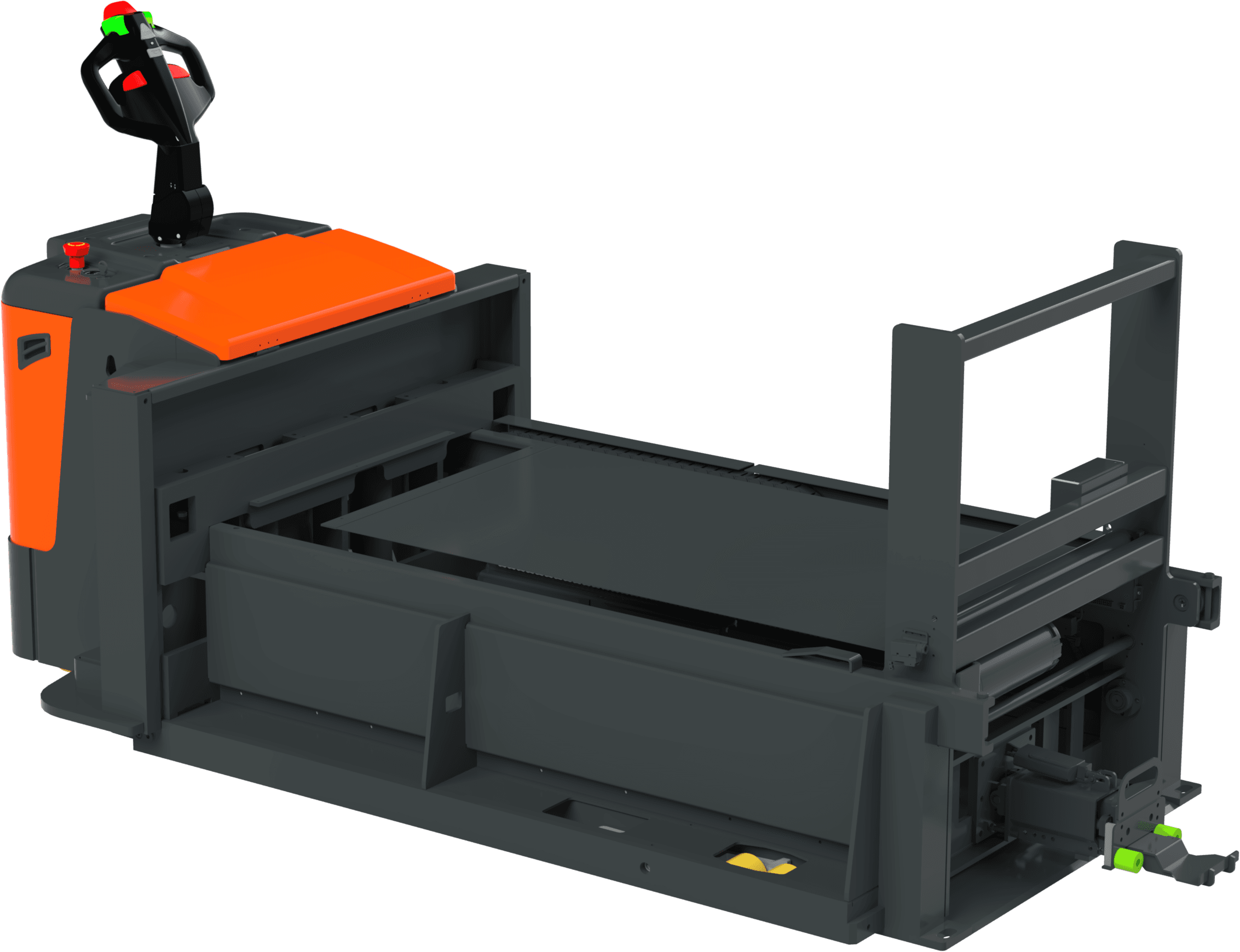
RT-PLD Server Mover
Ballymore RT-PLD Server Mover
Capacity
6,000 lbs
Single stable platform
Lift
16 in
Clears curbs and docks
Drive
Vertical
Tiller drive and steer
Security
Custom
Bracing and strap points
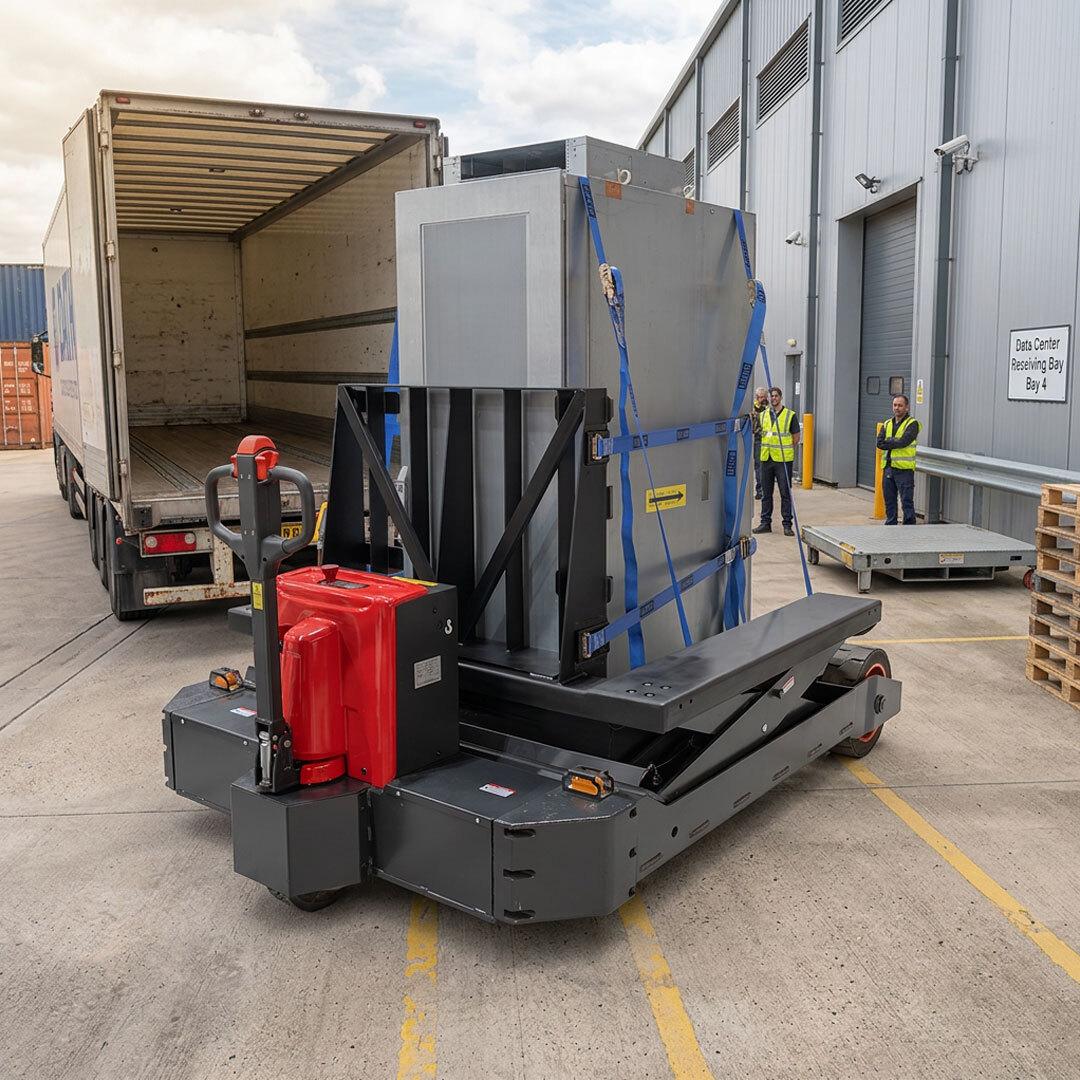
Transports fully loaded racks up to 6,000 lbs from the delivery truck to the data hall floor on a single stable platform. Eliminates the improvised ramps and manual methods typically used to clear curbs and dock transitions. Racks stay upright and padded throughout the move. Vertical tiller handle controls all drive and steering for one-operator use.
Request a Quote
Product Example
BALLYPAL-45L-63 Lithium Walkie Pallet Jack
Capacity
4,500 lbs
Medium to heavy duty
Battery
24V/100Ah
5hr fast charge
Speed
3.7 mph
Unloaded travel
Access
Pin/RFID
Secure operator control
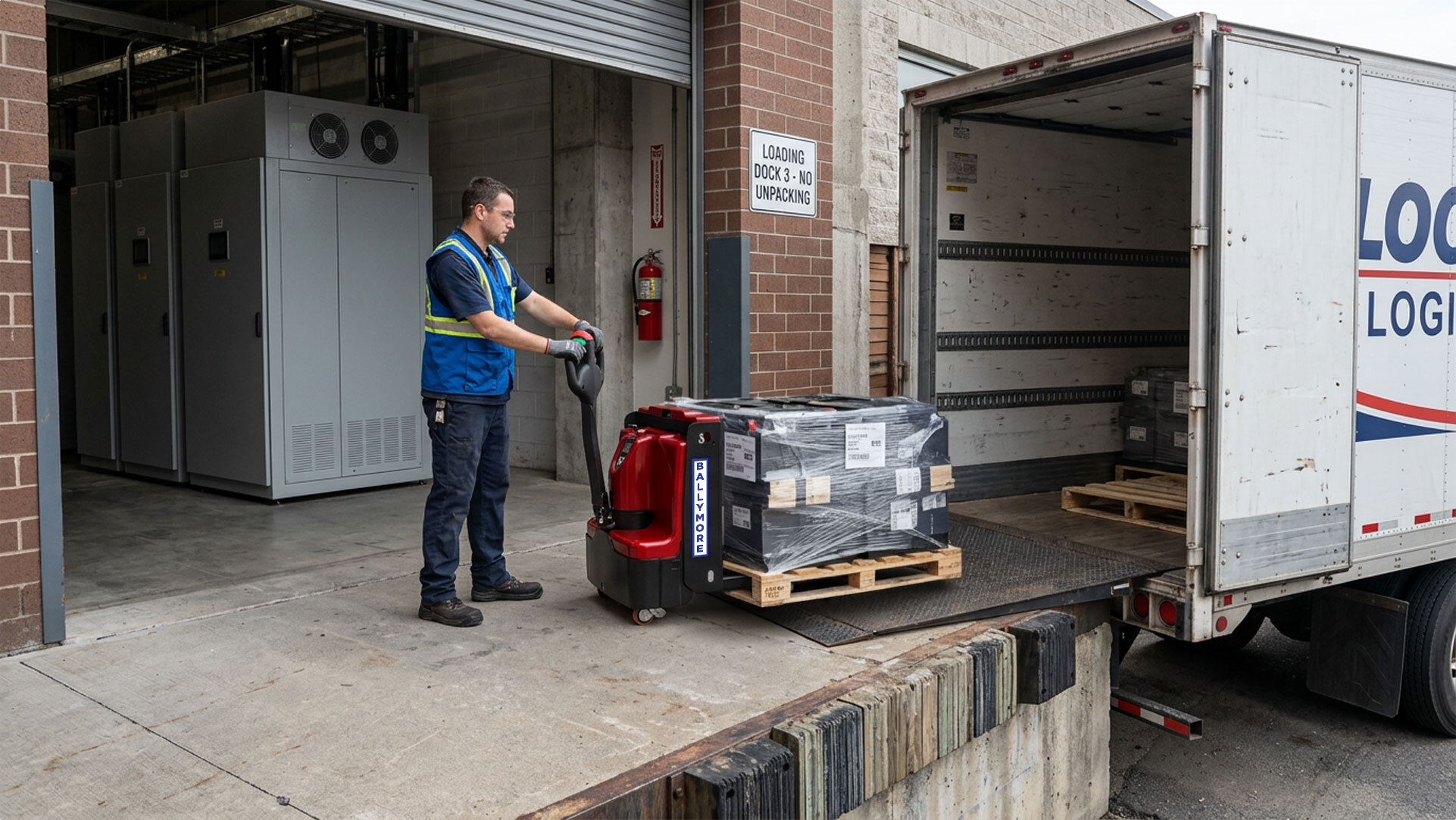
A lithium walkie pallet jack built for data center material handling. 4,500 lb capacity, pinwheel turning radius for tight aisles and loading docks, and AC drive motor with 24V speed control for smooth low-speed operation. Pin-code and RFID access control limits use to authorized operators. Charges fully in 5 hours from a standard outlet.
Request a Quote
Rolling Ladders · Hybrid Ladders · Work Platforms · Pallet Jacks · Stackers · Rack Movers · Lift Tables · Order Pickers
Serviced in All 50 States

Services & Software

Single-source preventive maintenance and compliance service for your full Ballymore equipment fleet, with complete asset tracking and OSHA and ESD compliance documentation built into every program.
DOC Services handles scheduled PM for your Ballymore access and material handling equipment so your in-house team stays focused on critical infrastructure. Regularly scheduled maintenance visits, full make-model-serial asset tracking, and a modular service structure that scales with your facility, all under one agreement and one point of contact.
Learn About DOC Services
Single Source Ownership
One contact, one agreement. Eliminates the gaps that come from managing multiple vendors across sites and service categories.
Full Asset Management
Make, model, serial number, and repair history tracked for every asset to support compliance documentation and capital planning.
OSHA and ESD Compliance
Compliance documentation built into every PM visit. Keeps your equipment program audit-ready and ESD requirements maintained over time.
Scales with Your Facility
Modular service structure expands as your equipment fleet and facility footprint grow, without renegotiating agreements.
BALLYQ
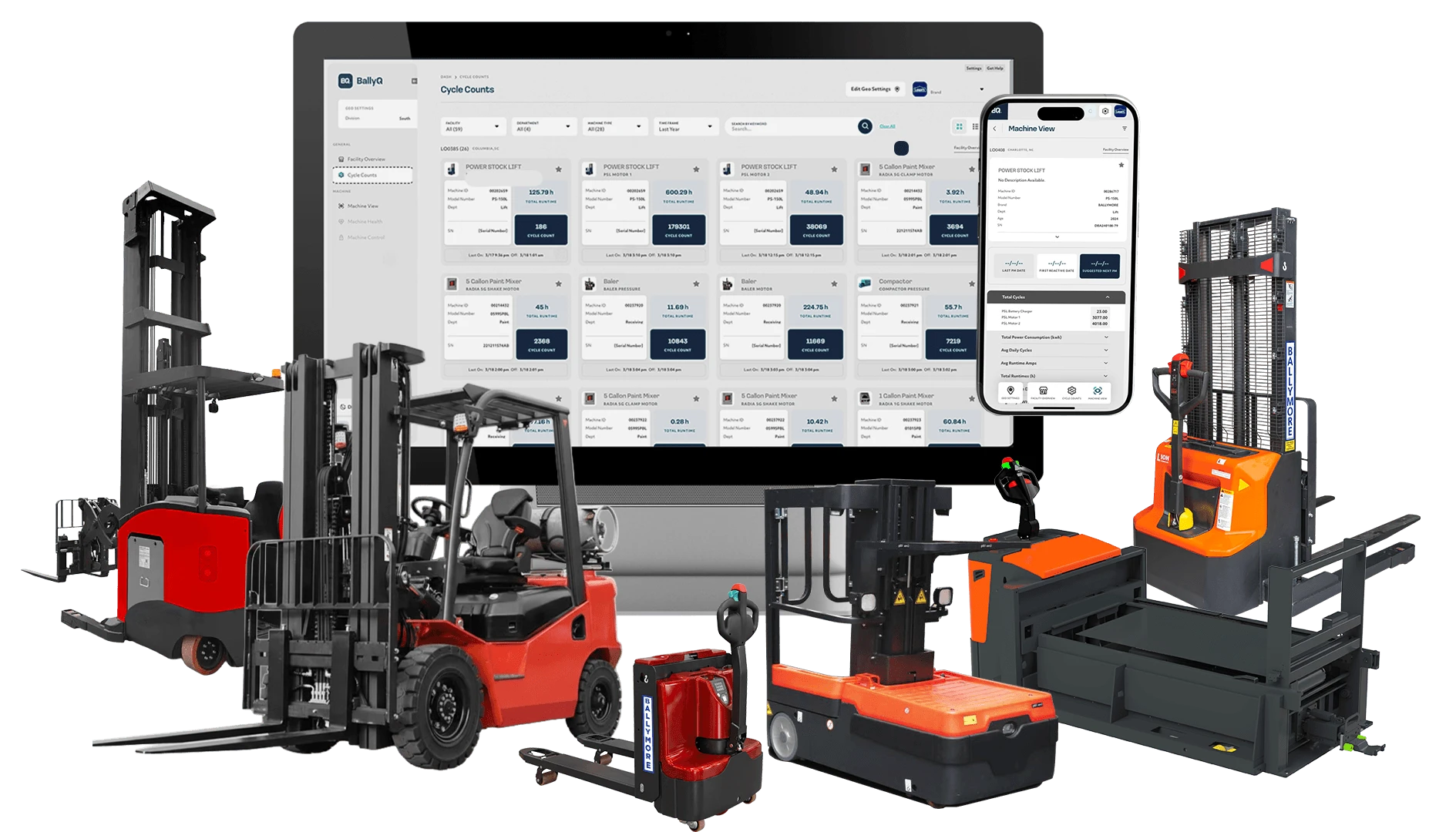
Centralized visibility into equipment status, inspection records, and compliance documentation across all sites and assets.
BallyQ gives data center facilities teams and EHS managers a single dashboard to track their access equipment fleet, stay ahead of inspection schedules, and generate audit-ready compliance reports without manual recordkeeping. Replaces the spreadsheet-and-clipboard approach that creates compliance gaps across multi-site operations.
Learn About BallyQ
Asset Tracking
Full inventory and inspection scheduling for every piece of access equipment across your data center locations.
Compliance Reporting
Audit-ready reports for OSHA requirements and internal safety program reviews, generated without manual data entry.
Multi-Site Dashboard
Consolidated fleet visibility for enterprise and hyperscale operators managing equipment across multiple facilities.
CMMS Integration
Designed to connect with existing facilities management and CMMS platforms. Confirm specific integrations with the Ballymore team.

Common Use Cases

Hyperscale Campus Operations

Managing rack access and equipment movement across millions of square feet requires standardized, durable access solutions that perform consistently across every hall and building.

Colocation Rack Maintenance

Colo technicians working across multi-tenant environments need fast-repositioning access equipment that keeps pace with high-frequency hot-swap, cabling, and rack maintenance demands.

Enterprise Server Room Access

In-house IT and facilities teams need OSHA-compliant access equipment that works safely on raised access floors without specialized training or disrupting day-to-day operations.

UPS & Battery Infrastructure

Scheduled UPS battery replacements require moving heavy loads through tight mechanical corridors safely. Proper material handling equipment eliminates the manual handling injuries during maintenance cycles.


Services & Software

Preventive maintenance, compliance inspections, and emergency repair for your full Ballymore equipment fleet — covered by a single nationwide service provider.

For data center operators managing equipment across multiple facilities, DOC Services eliminates the complexity of coordinating local vendors in every market. One service agreement, one point of contact, consistent documentation across every site.

Scheduled PM Programs

Preventive maintenance on defined intervals for ladders, lifts, and platforms.

Compliance Documents

Inspection records and service reports suitable for OSHA audits and internal reviews.

Nationwide Coverage

Technician network covering all major US data center markets.

Single Point of Contact

One service agreement for multi-site operators across regions.


Asset Tracking

Full inventory and inspection scheduling for every piece of access equipment across your facilities.

Compliance Reporting

Automated audit-ready reports for OSHA requirements and internal safety program reviews.

Multi-Site Dashboard

Consolidated fleet visibility for enterprise and hyperscale operators across all locations.

CMMS Integration

Connects with existing facilities management and CMMS platforms.

Real-time visibility into equipment status, inspection records, compliance documentation, and safety program performance across all sites and assets.

BallyQ gives data center facilities teams and EHS managers a single dashboard to track their access equipment fleet, stay ahead of inspection schedules, and generate audit-ready compliance reports without manual recordkeeping.

Services & Software
Preventive maintenance, compliance inspections, and emergency repair for your full Ballymore equipment fleet — covered by a single nationwide service provider.
For data center operators managing equipment across multiple facilities, DOC Services eliminates the complexity of coordinating local vendors in every market. One service agreement, one point of contact, consistent documentation across every site.
Learn About DOC Services
Scheduled PM Programs
Preventive maintenance on defined intervals for ladders, lifts, and platforms.
Compliance Documentation
Inspection records and service reports suitable for OSHA audits and internal reviews.
Nationwide Coverage
Technician network covering all major US data center markets.
Single Point of Contact
One service agreement for multi-site operators across regions.
BALLYQ
Real-time visibility into equipment status, inspection records, compliance documentation, and safety program performance across all sites and assets.
BallyQ gives data center facilities teams and EHS managers a single dashboard to track their access equipment fleet, stay ahead of inspection schedules, and generate audit-ready compliance reports without manual recordkeeping.
Learn About BallyQ
Asset Tracking
Full inventory and inspection scheduling for every piece of access equipment across your facilities.
Compliance Reporting
Automated audit-ready reports for OSHA requirements and internal safety program reviews.
Multi-Site Dashboard
Consolidated fleet visibility for enterprise and hyperscale operators across all locations.
CMMS Integration
Connects with existing facilities management and CMMS platforms.
Engineered Access Solutions
Built Around Your Facility
Standard products do not always fit. Data center rack rows, raised floor configurations, UPS corridors, and cable tray systems all vary by facility. Ballymore's Engineered Access Solutions team works directly with your facilities team to design and fabricate custom platforms, rolling systems, and fixed access structures built to your exact specifications.
Talk to an EAS Engineer
Data Center Safety
Frequently Asked Questions
Common questions about access equipment, material handling, and safety compliance for data center operations, maintenance, and fit-out.
What OSHA standards apply to ladders and elevated access in data centers?
Data centers operate under OSHA's General Industry standards, primarily 29 CFR 1910. Ladders are governed by OSHA 1910.23, which covers portable ladders and mobile ladder stands. Key requirements include: steps and rungs must be slip-resistant and uniformly spaced; ladders must support at least four times their maximum intended load; workers must maintain three points of contact when climbing or descending; and ladders must be inspected before each day of use by a competent person and immediately removed from service if found defective. Handrail requirements vary by top step height. For mobile ladder stands with a top step between 4 and 10 feet, handrails of 29.5 to 37 inches are required. Above 10 feet, the top step must be protected on three sides by a handrail of at least 36 inches. Walking-working surfaces including raised floor environments fall under OSHA 1910.22 and 1910.28, which require surfaces to be maintained in clean, dry, and orderly condition with fall protection at open-sided floors and platforms. OSHA's 2017 Walking-Working Surfaces final rule clarified that where employees routinely access the same area for operations or maintenance, fixed stairs are preferred over ladders where practical. Ballymore rolling safety ladders and work platforms are manufactured to meet OSHA 1910.23 requirements for general industry use.
How heavy are fully loaded server racks in modern data centers, and why does that matter for equipment handling?
Rack weights have increased significantly as data centers transition to high-density AI workloads. A traditional 42U server rack with a standard mix of compute and networking equipment typically weighs between 1,500 and 2,500 lbs when fully loaded. AI server racks incorporating multiple GPUs, liquid cooling distribution units, and dense networking hardware can exceed 4,000 lbs, and cooling distribution units flooded with water can weigh up to 3 tons. These weights have real implications for handling. Manual movement of loaded racks is not feasible and creates serious injury risk. Back and shoulder injuries are among the leading causes of lost workdays across all industries, and manual handling of heavy IT equipment is a documented contributor in data center environments. Powered pallet jacks, electric stackers, and purpose-built server rack movers are the appropriate tools for rack transport, installation, and relocation. For any load over 50 lbs, OSHA's material handling guidance recommends using mechanical aids to reduce ergonomic risk.
What are the ladder and access equipment requirements for data center raised floor environments?
Raised access floors create specific considerations that standard rolling ladders may not be designed to accommodate. Raised floor tiles are typically rated at 1,000 to 2,000 lbs concentrated load based on a defined contact area. A ladder with small caster contact points can concentrate load in a way that exceeds tile capacity and causes tile failure or displacement. Non-marring casters that distribute load across a broader contact area are the correct specification for ladder use on raised floors. Standard ladders with hard rubber or steel casters can damage tiles or create uneven surfaces. Raised floor transitions, grommets, and cable cutouts also create trip and repositioning hazards that must be managed carefully. For overhead work in hot aisles, the ladder must fit within the aisle width without blocking airflow containment systems. Ballymore's Hybrid Rolling Ladder is designed for raised floor data center environments, with non-marring casters and a compact footprint suited for hot and cold aisle configurations.
Does OSHA require certification to operate powered pallet jacks and material handling equipment in a data center?
Yes. Electric powered pallet jacks are classified by OSHA as Class III Powered Industrial Trucks and are subject to the full operator training and certification requirements of OSHA 29 CFR 1910.178(l), regardless of facility type. This applies in data centers just as it does in warehouses and manufacturing environments. Operators must complete formal instruction on safe operation and specific hazards, complete practical hands-on training, pass a documented performance evaluation, and be re-evaluated at least once every three years. Re-evaluation is also required if an operator is observed operating unsafely, is involved in an incident or near miss, or is assigned a different class of equipment. Data center facility managers are responsible for ensuring all technicians and contractors who operate powered pallet jacks during equipment moves and rack deployments are certified and that records are current. The requirement applies to contractors as well as direct employees. Server hardware manufacturers recommend a minimum two-person team for handling heavy rack equipment, and OSHA's material handling guidance reinforces that mechanical aids should be used for any load that creates ergonomic risk.
What is ESD compliance and how does it affect access equipment selection in a data center?
Electrostatic discharge (ESD) is the sudden flow of electricity between two objects at different electrical potentials. In a data center, ESD events can damage or destroy sensitive server and networking components, often at voltage levels below what a person can feel. Data centers with ESD-sensitive equipment may require that access equipment including ladders, platforms, and carts be ESD-compliant. ESD-compliant ladders and platforms use conductive or dissipative materials in step surfaces, handrails, and frame components to prevent static buildup and discharge. Standard industrial steel or aluminum ladders may not meet ESD requirements in sensitive zones. DOC Services includes ESD compliance checks in preventive maintenance programs for data center equipment fleets, helping ensure ladders and platforms remain in compliant condition as components wear over time. When selecting access equipment for ESD-sensitive environments, confirm with your equipment supplier that the product meets your facility's ESD specifications and that ongoing maintenance preserves that compliance.
How should data center operators manage access equipment compliance across multiple facilities?
Hyperscale and enterprise data center operators managing equipment across multiple facilities face a significant compliance challenge: each facility is independently subject to OSHA inspection, and a gap at any single location carries the same citation and liability exposure as a gap at a flagship site. The required compliance documentation includes pre-use inspection records for all ladders and platforms, periodic preventive maintenance records at defined intervals, operator training and certification records for all powered equipment, and removal-from-service documentation for any defective equipment. BallyQ is Ballymore Safety Group's asset management platform that gives facilities teams and EHS managers centralized visibility into their access equipment fleet across all locations, with inspection scheduling, service record tracking, and audit-ready compliance reporting. DOC Services provides scheduled preventive maintenance programs with nationwide technician coverage and standardized documentation across all facilities under a single agreement. For operators managing multiple sites across different markets, this eliminates the complexity and compliance gaps that come from coordinating local vendors at each location. Contact Ballymore to discuss a multi-site program for your data center portfolio.
What access equipment is recommended for overhead work in hot and cold aisle containment environments?
Hot and cold aisle containment systems create specific constraints for elevated access equipment. Aisle widths between rack rows in a standard data center are typically 36 to 48 inches. Hot aisle temperatures at rack face can exceed 100 degrees Fahrenheit, creating heat stress risk for workers performing overhead maintenance on cable trays, lighting, HVAC, and fire suppression systems. Access equipment for these environments must fit within the aisle width without contacting rack equipment or containment structures, be repositionable without disrupting airflow containment panels, and have non-marring casters appropriate for raised floor tiles. For overhead work beyond the reach of a standard rolling ladder, a compact order picker provides a stable elevated work platform. The Ballymore LIAM order picker is designed for tight data center aisle access in space-constrained environments. For sustained overhead tasks, a work platform with full guardrail provides a more stable and compliant solution than improvised access. Workers in hot aisles for extended periods should follow OSHA heat stress guidelines and take regular breaks in cooler areas.
How does BallyQ access control help data center security teams manage equipment operations?
Data centers operate under strict physical security protocols where knowing who accessed what equipment and when is as important as knowing who accessed which server cage. BallyQ is Ballymore Safety Group's proprietary access control system that logs every operation of a powered piece of equipment by operator, time, and location. For data center security teams, BallyQ provides an audit trail for every powered pallet jack, stacker, and material handling unit on the floor, giving the same level of operational accountability that badge access systems provide for physical server cage entry. BallyQ integrates with keypad entry and physical key locks, giving security managers control over which operators are authorized to move equipment in sensitive areas such as UPS battery rooms and active server floors. For hyperscale and colocation operators where contractor access to the data hall is strictly controlled, BallyQ ensures equipment operation is limited to trained, authorized personnel with a timestamped record suitable for security audits and incident investigations.
What is the safest way to move a fully loaded server rack within or between data center facilities?
Moving a fully loaded server rack is one of the highest-risk material handling operations in a data center, combining extreme weight, fragile and expensive equipment, tight aisle clearances, and raised floor tile integrity concerns. Manual pushing and pulling of a loaded rack is not a safe or appropriate method. For moving a rack within an active data hall, a powered rack mover purpose-built for data center aisles provides controlled, low-speed movement without the space requirements of a standard powered industrial truck. The Ballymore Rack Mover handles racks up to 7,500 lbs with two operators, compared to the six-person crew previously required for the same task. For moving racks from a delivery truck to the data hall floor, a dedicated server transport platform that bridges dock transitions without ramps is the correct solution. The Ballymore RT-PLD Server Mover handles loads up to 6,000 lbs on a single stable platform with 16 inches of lift to clear curbs and dock transitions. For any rack move, a minimum two-person operation is recommended for loads over 50 lbs, with mechanical assistance for all full rack moves. Rack casters should be inspected before any move, and floor tile integrity along the travel path verified in advance.
How often should data center access equipment be inspected and maintained?
OSHA 1910.23 requires that all ladders be inspected before each day of use by a competent person, defined as someone capable of identifying existing and predictable hazards and authorized to take corrective action. Any ladder found to have a structural defect must be immediately removed from service and tagged out. For powered material handling equipment including pallet jacks and stackers, OSHA 1910.178 requires examination before each shift and after any event that may have caused damage, with unsafe equipment removed from service until restored to safe operating condition. Beyond daily pre-use inspection, data center access equipment should be on a documented preventive maintenance schedule. The appropriate interval depends on usage frequency, but high-cycle environments typically warrant quarterly or semi-annual PM visits at minimum. DOC Services provides scheduled PM programs covering all Ballymore equipment across data center locations under a single service agreement, with documentation suitable for OSHA compliance audits. Equipment without a defined, documented maintenance schedule creates both a safety risk and a compliance liability that becomes particularly significant if an injury occurs.

Frequently Asked Questions

What OSHA standards apply to ladders and access equipment in data centers?

OSHA 29 CFR 1910.23 governs portable ladders in general industry, including rolling safety ladders used in data center rack rooms. ANSI A14.7 is the specific standard for rolling safety ladders. OSHA 1910.29 covers fall protection systems on elevated platforms. For data centers under active construction or fit-out, the construction standards under 29 CFR 1926 apply instead.

What fall protection is required when working at heights in a data center?

Under OSHA 29 CFR 1910.28, fall protection is required at heights of 4 feet or more in general industry. For elevated work platforms, guardrail systems with self-closing gates are the preferred engineering control as they protect workers passively without requiring PPE. Ballymore work platforms include full perimeter guardrails and self-closing safety gates as standard.

Will standard ladder casters damage raised floor tiles in a data center?

Yes. Hard polyurethane or steel casters can scratch and crack raised access floor tiles, which are costly to replace and disruptive to airflow management. Ballymore Hybrid Rolling Ladders use non-marring rubber casters designed specifically for raised floor environments. The weight-actuated lockstep also prevents the ladder from drifting under load.

Can Ballymore build custom platforms for non-standard rack configurations?

Yes. Ballymore's Engineered Access Solutions team designs and fabricates custom platforms, narrow-aisle rolling systems, and fixed access structures for facilities where standard products don't fit. Common projects include custom-width platforms for non-standard aisle widths and UPS room platforms built to exact dimensions. Lead times are typically 4 to 8 weeks from drawing approval.

What is DOC Services and what does it cover for data center operators?

DOC Services is Ballymore's nationwide field service program covering preventive maintenance, compliance inspections, and repair for the full Ballymore product family. For operators managing equipment across multiple facilities, DOC eliminates the need to coordinate local vendors in each market. Service agreements include scheduled on-site inspections, documented service reports, and OSHA compliance verification through a single point of contact.

What is BallyQ and how does it help data center safety teams?

BallyQ is Ballymore's safety intelligence software that gives facilities and EHS teams full visibility into their access equipment fleet. It tracks asset inventory, inspection schedules, service history, and compliance status across all sites. For hyperscale and multi-site operators, BallyQ provides a consolidated dashboard and generates audit-ready OSHA compliance reports automatically, replacing manual spreadsheet recordkeeping.

What weight capacity do I need for a data center rolling ladder?

Standard rolling ladders are rated at 350 lbs. However, data center technicians often climb while carrying tools and components, so capacity matters. Ballymore's Hybrid series is rated at 450 lbs and is the most commonly specified model for rack-room environments. The Work Titan heavy-duty series is rated at 800 lbs for facilities requiring additional capacity.