










Food & Beverage


When Downtime Isn't an Option, Access Matters
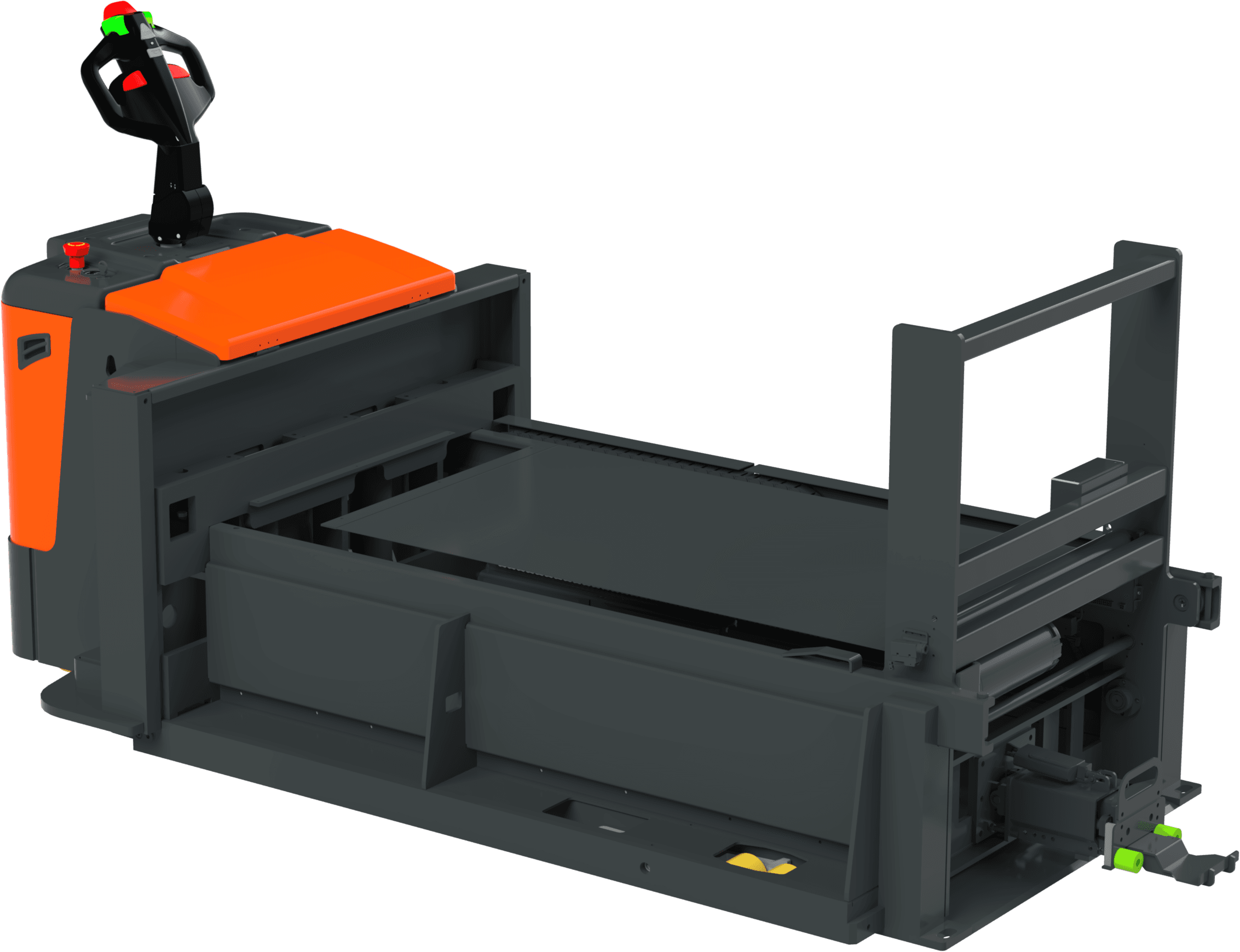
One wrong move in a rack room costs more than the equipment. Ballymore's access solutions are built around the unique constraints of data center environments, including tight aisles, raised floors, and zero tolerance for disruption
Food & Beverage
Washdown-ready access and material handling equipment built for the sanitation standards of food and beverage processing, packaging, and distribution facilities.

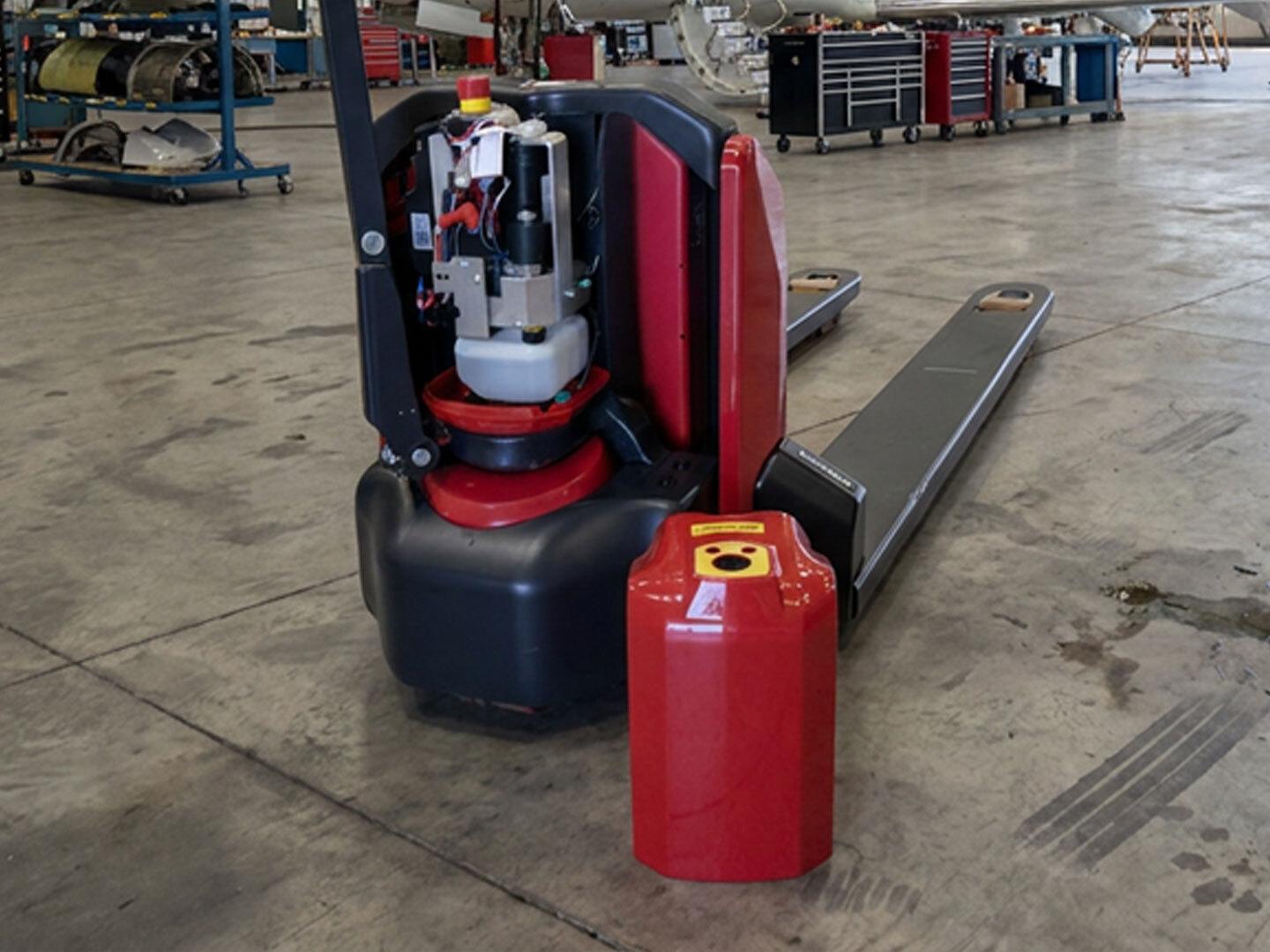
Ballymore Rack Mover
Featured Product
Rack Mover
7,500 lb capacity. Moves a loaded server rack with two people instead of six.
Learn More

Challenges & Solutions
The Challenge
Ladders That Corrode and Fail Under Constant Washdown
Daily sanitation cycles with high-pressure hot water, caustic cleaners, and chlorine-based sanitizers eat through standard powder-coated steel fast, and a corroding step or handrail is exactly the kind of defect that requires the ladder be pulled from service immediately.
The Solution
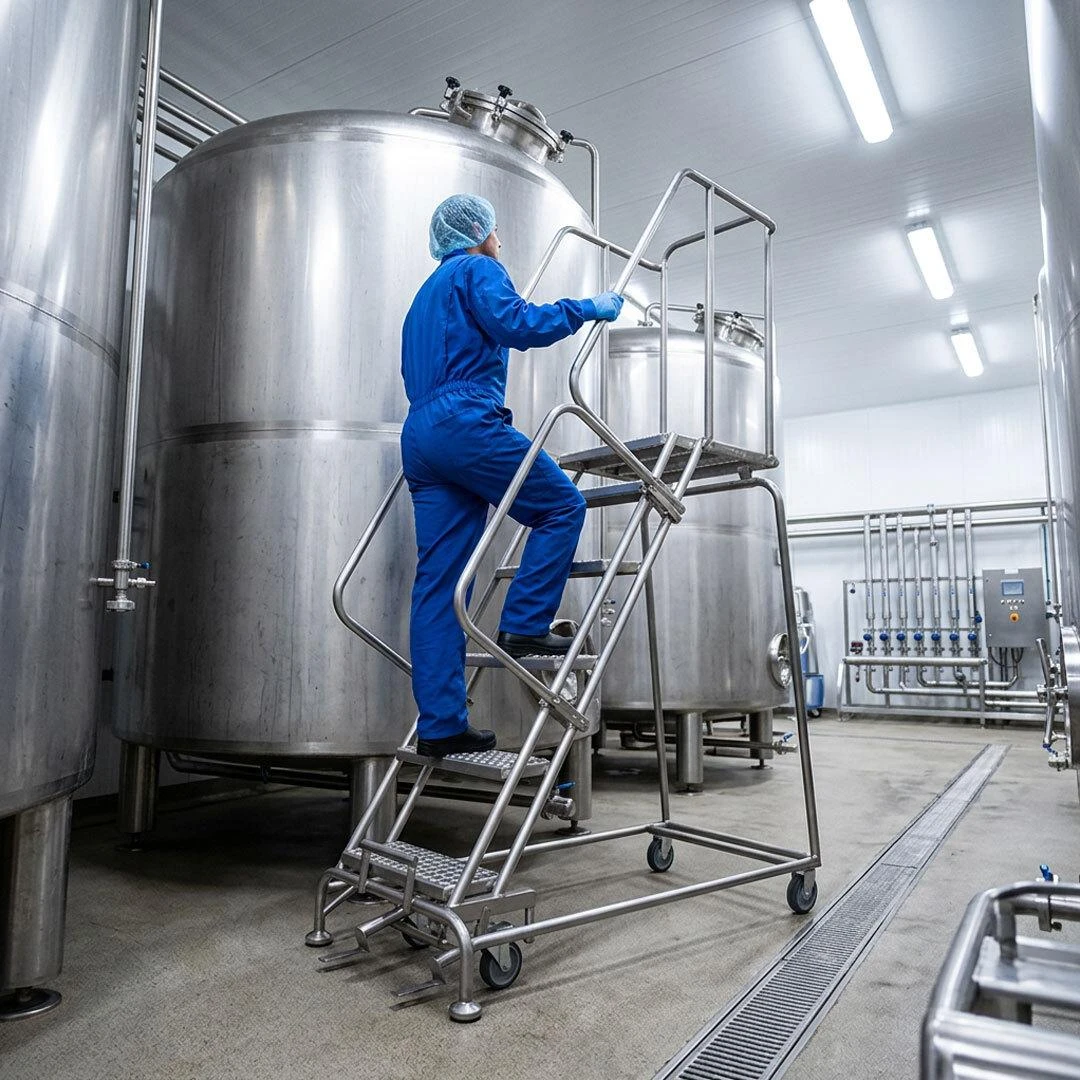
Stainless Steel Rolling Ladder
Ballymore
Built from Type 304 stainless steel with a bead-blasted finish that hides scratches and resists washdown and sanitizing chemicals. Perforated steps drain water instead of pooling it, and spring-loaded casters retract under the operator's weight so the ladder locks in place the moment someone steps on, then rolls freely once they step off. Available from 3 to 7 steps, including Cal/OSHA compliant configurations with 42-inch handrails.
View Product
Stainless Steel Rolling Ladder
The Challenge
Storing Rolling Access Equipment Between Sanitation Cycles
Processing floors clear out for washdown multiple times a shift, and a rolling ladder left standing in the aisle is one more piece of equipment blocking hose access and floor drainage.
The Solution
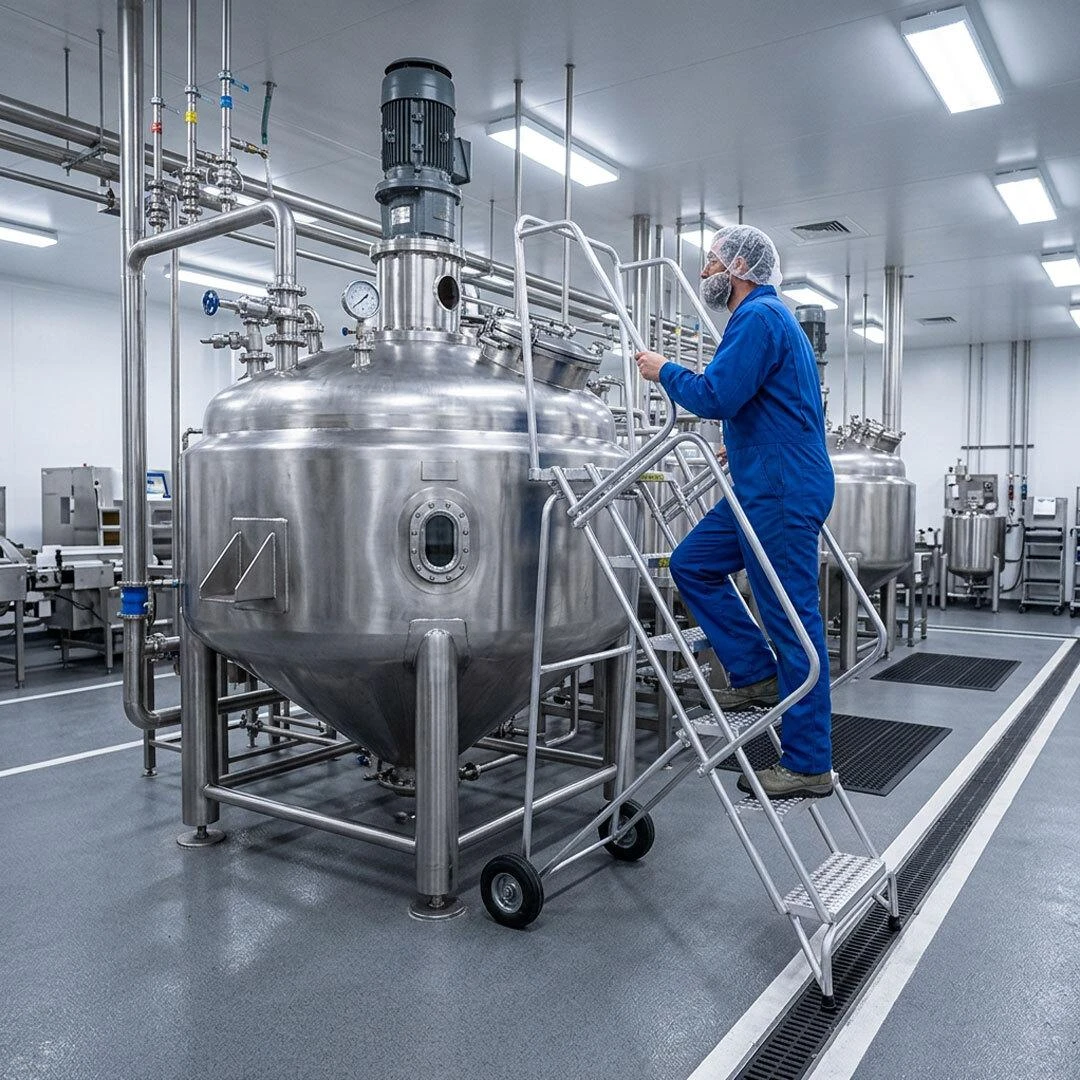
Stainless Steel Fold and Store Ladder
Ballymore
Folds flat for compact storage against a wall or in a corner between uses, then unfolds back into a full stainless steel rolling ladder when it is needed again. Same Type 304 construction and perforated drainage tread as Ballymore's standard stainless ladders, sized for tight processing floor footprints.
View Product
Stainless Steel Fold and Store Ladder
The Challenge
Safe Access to Refrigeration Units on Trucks and Trailers for Maintenance
Reefer units mounted on the front of refrigerated trucks and trailers need regular maintenance and inspection to keep the cold chain intact, but that work happens well above ground level with no built-in fall protection, and improvised access is exactly how a routine repair turns into a fall injury.
The Solution
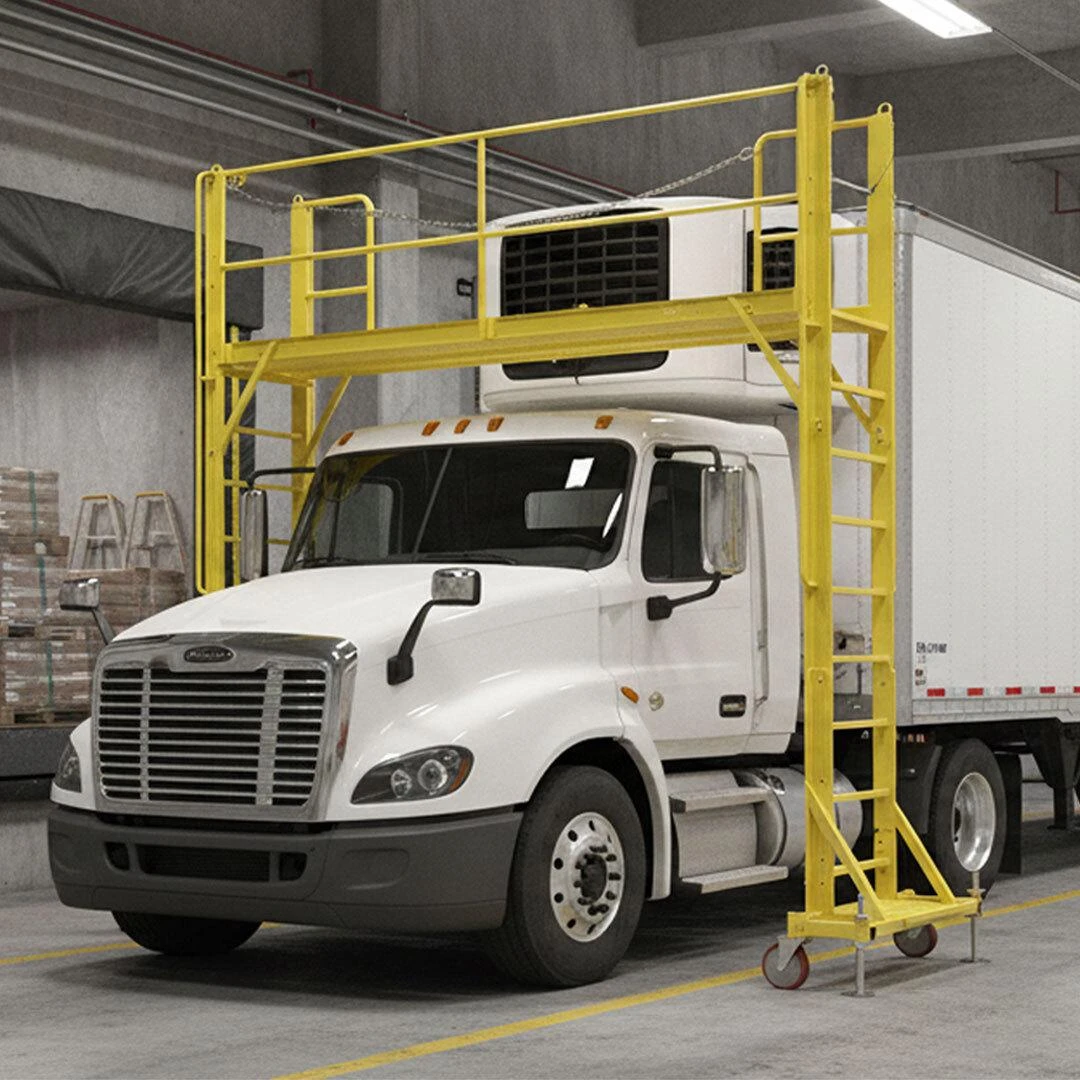
Rolling Work Platform
Tri-Arc
A 7-step rolling work platform that adjusts from 103 to 115 inches in 4-inch increments to match different truck and trailer heights, with dual-sided ladder access, a large 24 by 120.5 inch serrated platform for slip resistance and drainage, and snap chains at every entry point and the refrigeration unit access opening. Reinforced lifting points and easy-to-use outriggers keep the platform stable while technicians work on the unit itself.
View Product
Rolling Work Platform
The Challenge
Moving Ingredient Drums Without Manual Lifting or Tipping
Oils, syrups, brine, and bulk liquid ingredients commonly arrive in 55-gallon drums that weigh 400 lbs or more when full, and manually tipping or rolling a drum to pour or reposition it is exactly the kind of task that leads to back injuries and spills on a wet floor.
The Solution
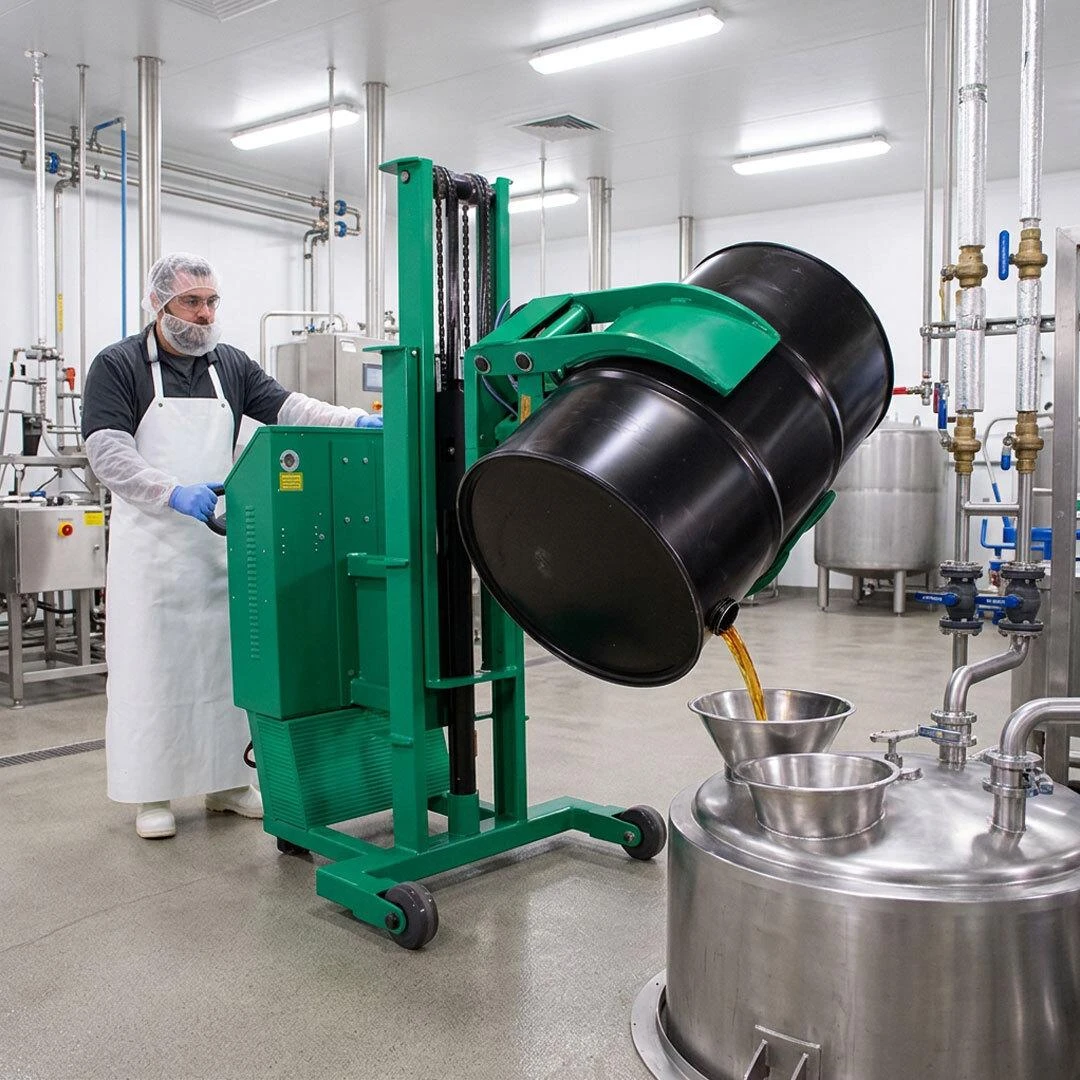
Drum Lift and Rotator
Valley Craft
Lifts, tilts, and rotates drums under power for controlled positioning and pouring. Removes the manual handling that leads to back injuries and product loss when ingredient drums are tipped by hand.
View Product
Drum Lift and Rotator
The Challenge
Elevated Access to Overhead Piping and Equipment in Tight Processing Aisles
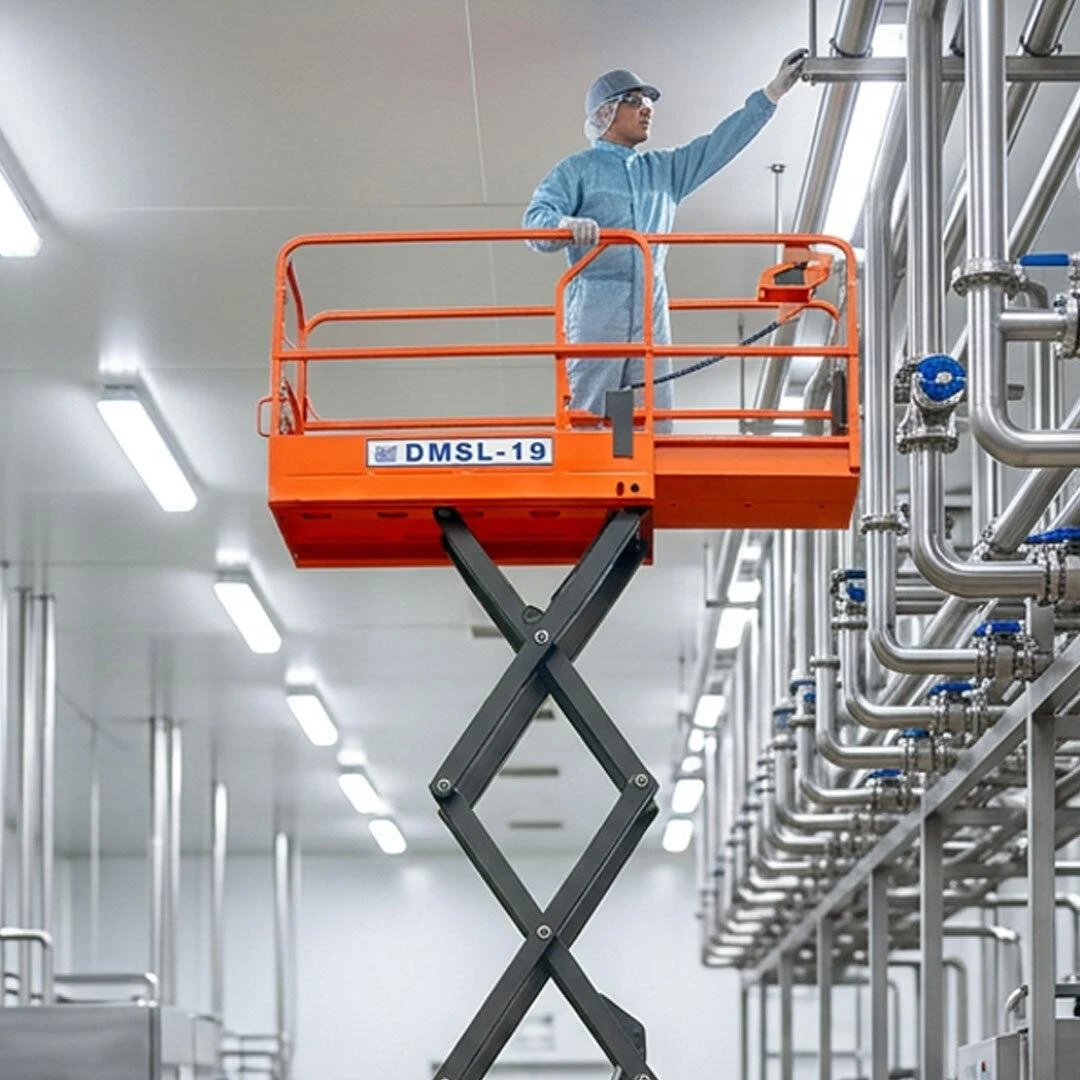
Overhead pipe runs, valves, and mixing equipment need periodic access for maintenance and inspection, but a standard scissor lift often cannot fit the aisle widths common on a processing floor built around fixed tanks and lines.
The Solution
DMSL-19 Drivable Mini Scissor Lift
Ballymore
A compact, drivable scissor lift with a 19-foot platform height and 500 lb capacity, sized to maneuver through tight aisles that a standard scissor lift cannot reach. Built for indoor use around fixed processing equipment.
View Product
DMSL-19 Drivable Mini Scissor Lift
The Challenge
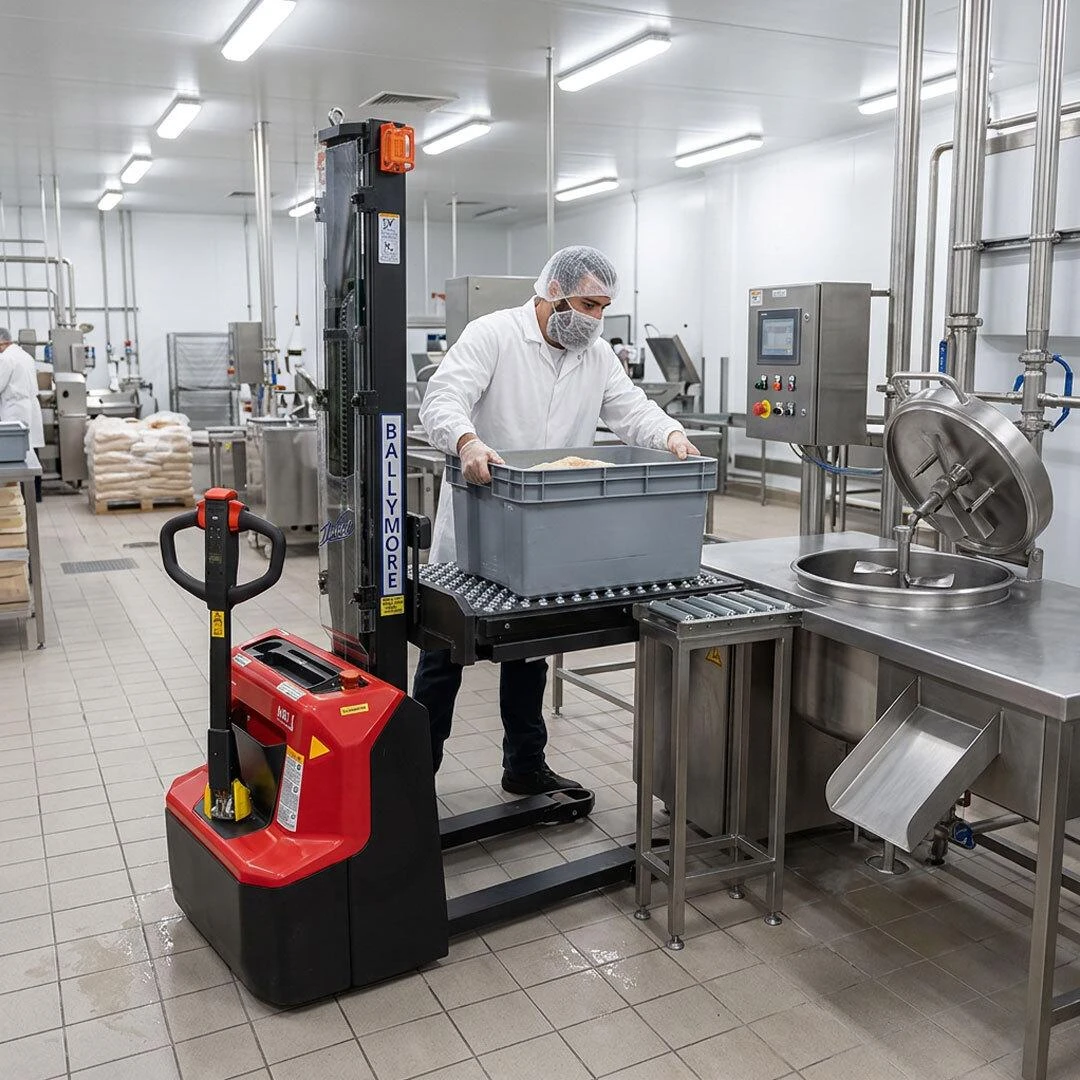
Repositioning Heavy Totes and Ingredient Containers for Mixing or Transfer
Moving a heavy tote or container into position at a mixing station or fill line without lifting it by hand is a recurring task on a processing floor, and doing it manually strains the same muscles the same way every single time.
The Solution
Lucy Ball Transfer Table
Ballymore
A fully powered ball conveyor transfer table that adjusts from 6.5 to 72 inches in height and handles loads up to 500 lbs, letting operators slide heavy totes and containers into position at a mixing station or fill line without lifting.
View Product
Lucy Ball Transfer Table

Common Use Cases
Dairy Processing
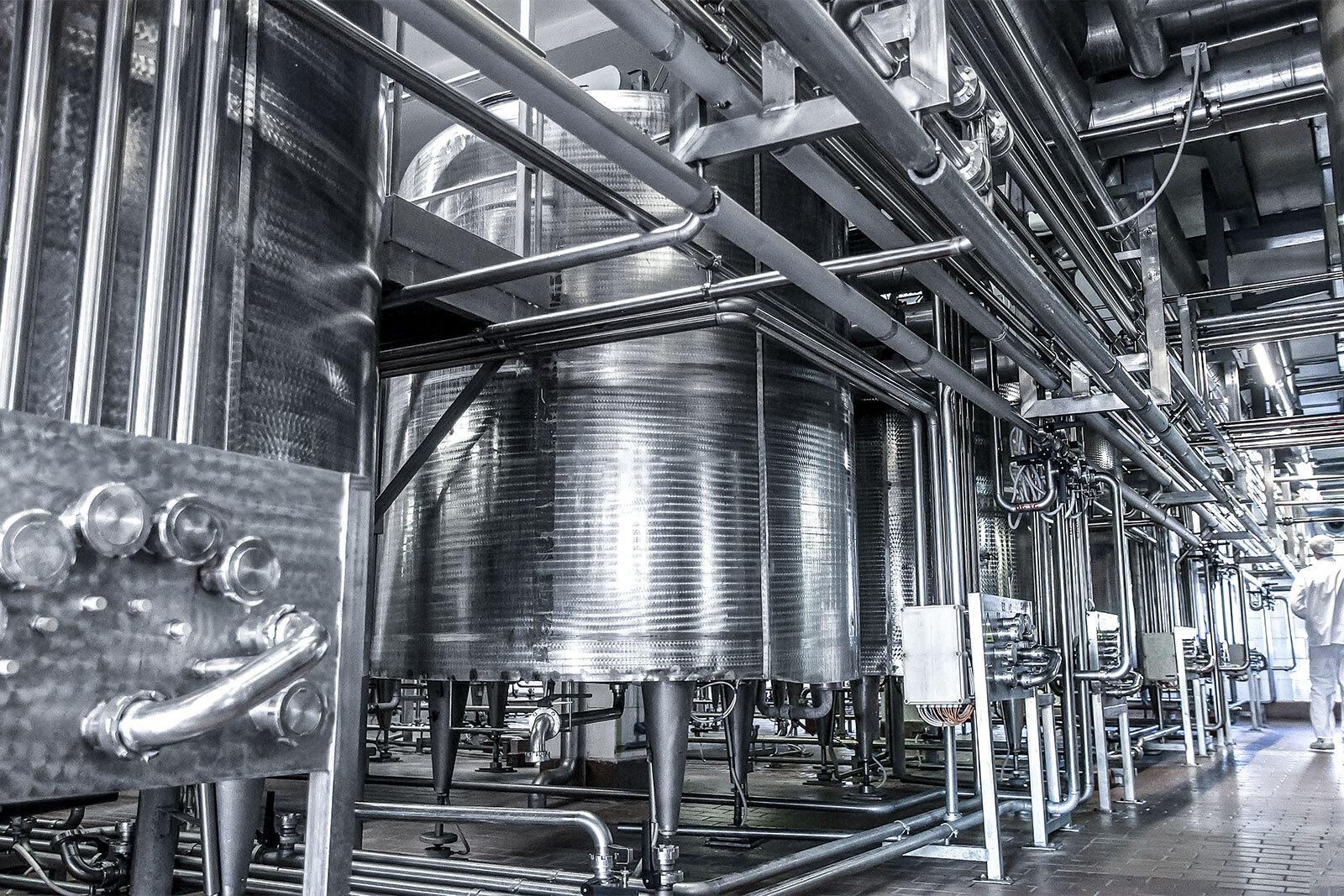
Pasteurizers, storage tanks, and bottling lines run wet nearly around the clock, and equipment that is not built for constant moisture and near-freezing storage temperatures corrodes fast. Stainless access equipment rated for both washdown chemicals and cold environments keeps operators moving between tanks without a mid-shift equipment failure.
Dairy Processing
Meat & Poultry Processing
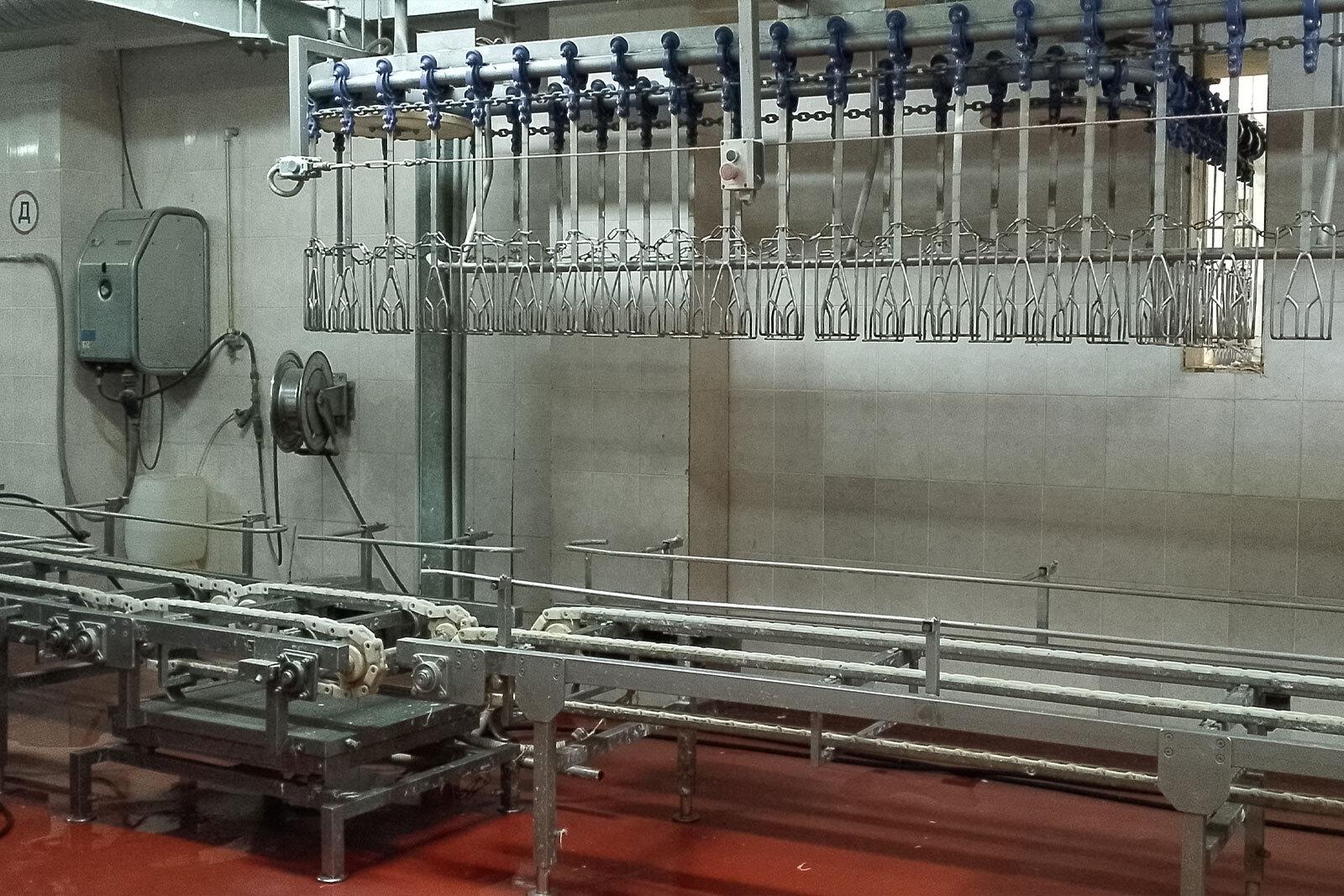
USDA-inspected facilities run some of the most aggressive sanitation cycles in food manufacturing, with hot water, caustic cleaners, and daily deep cleans that standard powder-coated equipment cannot survive for long. Stainless steel access and material handling equipment holds up to that cycle without becoming a harborage point for bacteria.
Meat & Poultry Processing
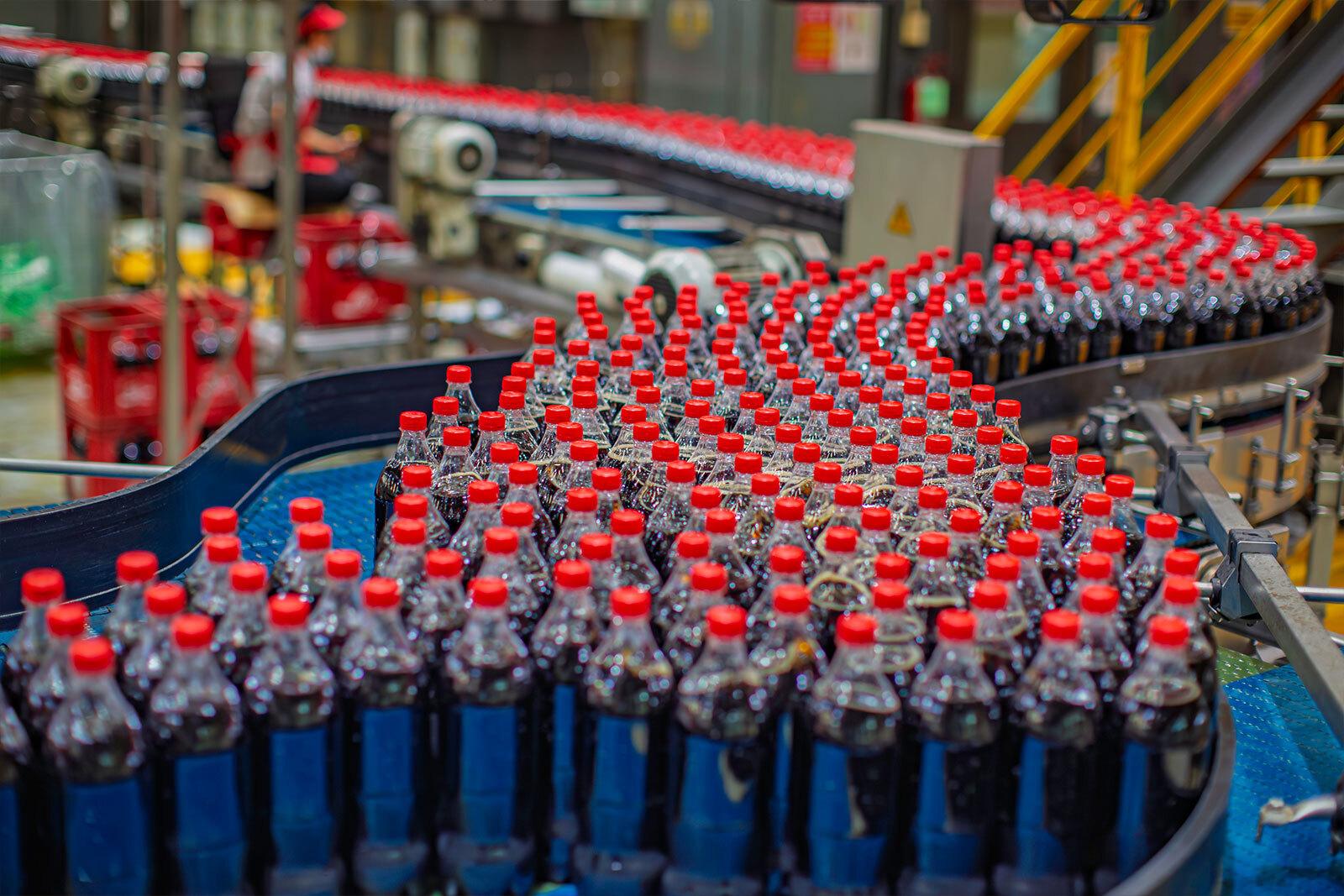
Beverage Bottling & Canning
High-speed filling and capping lines need operators reaching in for adjustments, jam clearing, and inspection dozens of times a shift, and a ladder or platform that cannot reposition quickly becomes the reason the line stays down longer than it needs to. Rolling stainless equipment keeps pace with line speed instead of slowing it down.
Beverage Bottling & Canning
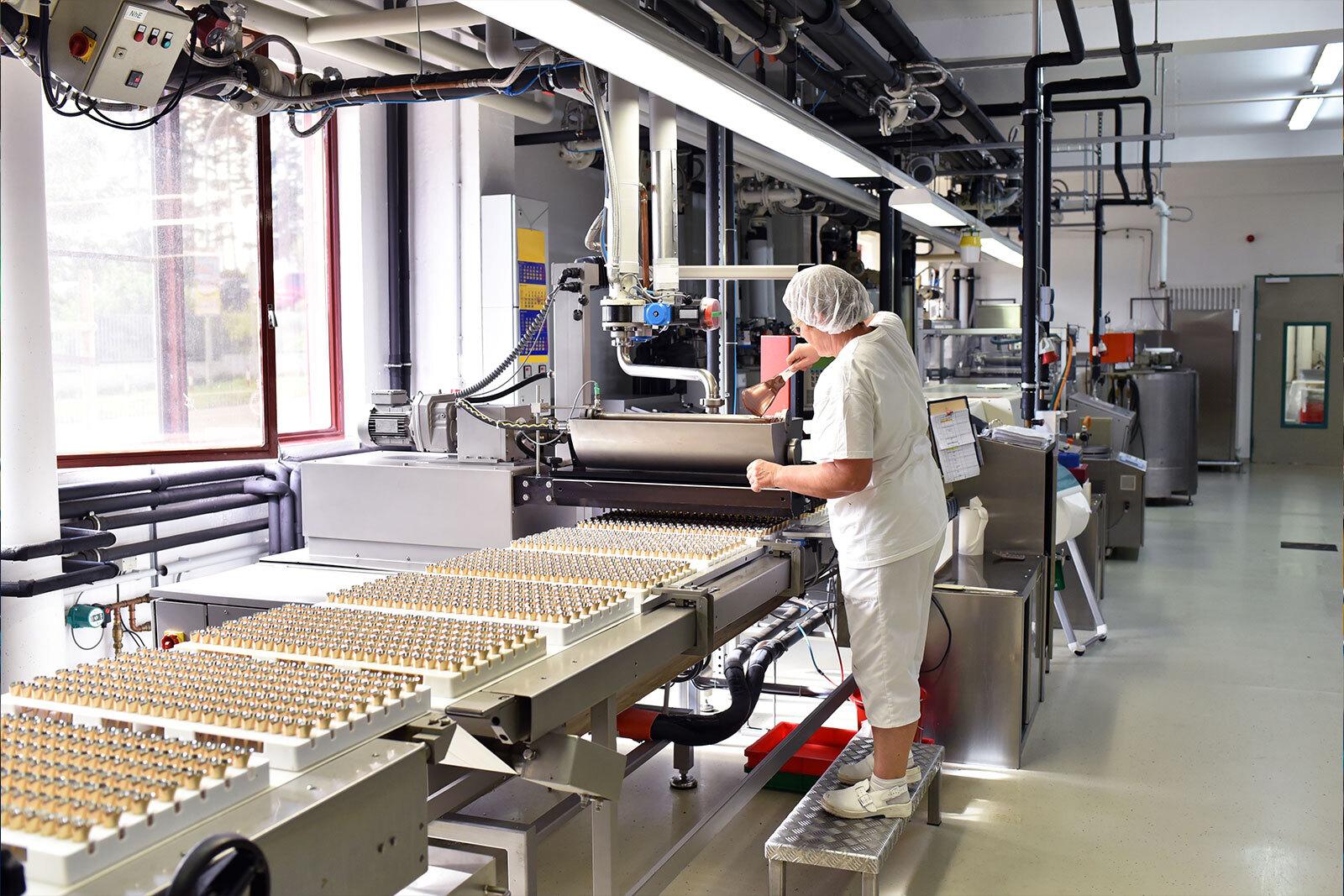
Bakery & Snack Food Production
Flour dust, sugar residue, and dry ingredient handling create their own access challenges. Tall mixers, ovens, and packaging equipment all need safe elevated reach without introducing more dust or debris into the air. Ladders and platforms with the right tread and mobility keep bakery floors moving without adding contamination risk.
Bakery & Snack Food Production
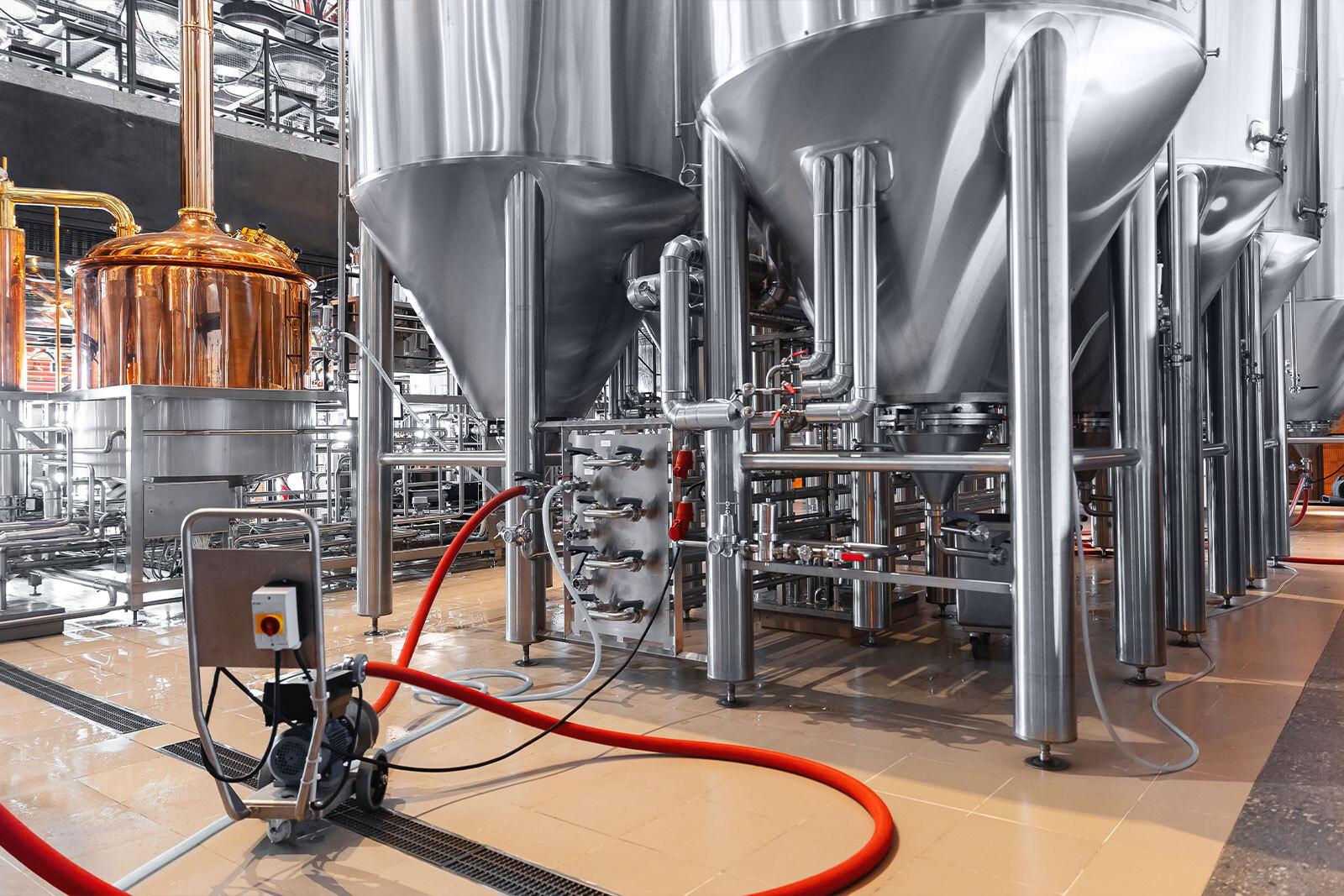
Brewery & Distillery Operations
Fermentation tanks, mash tuns, and kegging lines all require repeated elevated access for sampling, cleaning, and transfer, often within tight brewhouse footprints. Tilt-and-roll and rolling stainless ladders give brewers repeatable access to the same tank without a fixed catwalk eating up floor space.
Brewery & Distillery Operations

Trusted Partners

Aldi logo Aldi logo
Cracker Barrel logo Cracker Barrel logo
Krispy Kreme logo Krispy Kreme logo
McDonald's logo McDonald's logo
Sprouts logo Sprouts logo
Total Wine logo Total Wine logo
Built for the Data Center Floor
What facilities operators and EHS teams gain, and the equipment behind it.
Uptime
Protect Live Equipment
A populated rack never gets muscled into place next to live gear, so a routine job does not become an incident. The right access equipment keeps maintenance predictable and downtime off the schedule.
Server & Rack Lift
Speed to Deployment
Compress the Schedule
An existing lift that fits most racks with little to no modification, and ships fast so capacity moves now. Shorter lead times mean fit-out timelines stay on track regardless of facility size.
Existing Lift + Fast Ship
Safety
Personnel and Equipment
AI servers now regularly exceed 300 lbs. Powered lifts, pallet jacks, and stackers take that load off people's hands and keep both personnel and equipment protected during installation and maintenance.
Powered Lifts, Jacks & Stackers
Security
Control Who Operates
Access control built directly into the equipment. BallyQ software, keypad entry, and physical key locks restrict operation to authorized personnel, a critical requirement in high-security data center environments.
BallyQ, Keypad & Key Locks
Productivity
Do More With Fewer Hands
Powered equipment lets one worker move and place loads that used to take a crew, so the same team covers more racks, more floors, and more shifts without adding headcount.
Powered Jacks, Stackers & Tugs
Customization
Built to Your Need
When a standard unit does not fit the application, Ballymore's in-house engineering team designs and manufactures a turnkey solution built specifically for your facility, your aisle width, and your load.
In-House Engineering & Turnkey
Built for the Data Center Floor
What facilities operators and EHS teams gain, and the equipment behind it.
Uptime
Protect Live Equipment
A populated rack never gets muscled into place next to live gear, so a routine job does not become an incident. The right access equipment keeps maintenance predictable and downtime off the schedule.
Server & Rack Lift
Case Study
Live Rack Access Without Incident
A hyperscale operator running 24/7 maintenance needed a way to access populated racks in narrow hot aisles without risking adjacent live equipment. The Hybrid Rolling Ladder's non-marring casters and Lift Assist Lockstep meant technicians could reposition safely between racks without a second person or a shutdown window.
View Data Center Equipment
Speed to Deployment
Compress the Schedule
An existing lift that fits most racks with little to no modification, and ships fast so capacity moves now. Shorter lead times mean fit-out timelines stay on track regardless of facility size.
Existing Lift + Fast Ship
Why It Matters
Ship-Ready Equipment, No Modification Required
Data center fit-outs run on tight schedules. Ballymore's standard rack lifts and rolling ladders are designed to fit most rack row configurations without custom fabrication. Most orders ship within standard lead times so your deployment timeline stays on track.
Request a Quote
Safety
Personnel and Equipment
AI servers now regularly exceed 300 lbs. Powered lifts, pallet jacks, and stackers take that load off people's hands and keep both personnel and equipment protected during installation and maintenance.
Powered Lifts, Jacks & Stackers
OSHA Compliance
OSHA 1910-Compliant Access for Data Center Environments
AI server hardware now regularly exceeds 300 lbs per unit. Manual handling at that weight is both a safety violation and an equipment risk. Ballymore's powered lifts, pallet jacks, and stackers are OSHA 1910-compliant and built specifically for raised floor environments where standard industrial equipment cannot operate safely.
View Lift Safety Resources
Security
Control Who Operates
Access control built directly into the equipment. BallyQ software, keypad entry, and physical key locks restrict operation to authorized personnel, a critical requirement in high-security data center environments.
BallyQ, Keypad & Key Locks
BallyQ Access Control
Know Who Operated the Equipment and When
BallyQ is Ballymore's proprietary access control system. It logs every operation by operator, time, and location. Combined with keypad entry and physical key locks, it gives data center security teams a complete audit trail for every piece of powered equipment on the floor.
Learn About BallyQ
Productivity
Do More With Fewer Hands
Powered equipment lets one worker move and place loads that used to take a crew, so the same team covers more racks, more floors, and more shifts without adding headcount.
Powered Jacks, Stackers & Tugs
Labor Impact
One Operator. One Shift. More Ground Covered.
A single operator with a powered pallet jack or tug can move battery pallets, server hardware, and rack components that previously required two or three people. Across a full fit-out or maintenance cycle, that difference compounds into significant labor cost savings and faster project completion.
View Products
Customization
Built to Your Need
When a standard unit does not fit the application, Ballymore's in-house engineering team designs and manufactures a turnkey solution built specifically for your facility, your aisle width, and your load.
In-House Engineering & Turnkey
Custom Build Example
Custom Server Mover for a Hyperscale Operator
A major data center operator needed a purpose-built server mover that could navigate 24-inch hot aisles, handle loads up to 500 lbs, and meet their internal safety certification requirements. Ballymore's EAS engineering team designed, fabricated, and delivered a turnkey solution in 8 weeks. No off-the-shelf product existed that could do the job.
Talk to an EAS Engineer
Built for the Food & Beverage Floor
What operators gain, and the equipment behind it
Uptime
Sanitation and CIP cycles eat into the schedule daily. Equipment that survives them keeps that schedule intact.
Clean-in-place and washdown cycles are a required part of daily production in food and beverage plants, and equipment that cannot survive that cycle becomes downtime of its own. Ballymore's stainless steel ladders and platforms are built with Type 304 stainless and perforated drainage tread specifically to withstand daily washdown without the corrosion that pulls standard powder-coated equipment out of service.
Speed to Deployment
Standard Ballymore stainless ladders and platforms ship from stock, no custom fabrication wait.
A sanitation audit or a new production line does not leave room for a six-week fabrication lead time on access equipment. Ballymore's stainless steel rolling and folding ladders are standard catalog products that ship from stock on normal lead times and are already built to the washdown standard most processing floors require.
Safety
Food manufacturing injury rates run meaningfully higher than the broader manufacturing sector. The right equipment is one of the more direct levers to close that gap.
BLS data puts the food manufacturing sector's total recordable injury and illness rate at roughly 3.3 to 3.6 cases per 100 full-time workers in recent years, compared to about 2.7 for all manufacturing and 2.6 for all industry combined. Wet floors, improvised access to tanks and mixers, and manual ingredient handling are recurring contributors. Stainless ladders with non-marring, self-draining tread and powered drum and tote handling equipment address the access and lifting side of that gap directly.
Security
FSMA's Intentional Adulteration Rule ties food defense directly to physical access control. Equipment access is part of that picture.
Since 2019, FSMA's Mitigation Strategies to Protect Food Against Intentional Adulteration Rule has required roughly 3,400 covered food companies operating 9,800 facilities to maintain a written food defense plan, including a vulnerability assessment that explicitly considers the degree of physical access to product at each actionable process step. BallyQ is Ballymore's access control system, logging every operation of a powered piece of equipment by operator, time, and location, giving food safety and security teams a documented layer of physical access accountability at the equipment level.
Productivity
Unplanned downtime is one of the most expensive line items in food and beverage production. Reliable access equipment is a controllable piece of that number.
Industry research consistently puts unplanned downtime losses somewhere between 5 and 20 percent of total production capacity a year for food and beverage manufacturers, with equipment failure accounting for a large share of those stoppage events. A ladder or platform that fails under washdown, or access equipment that cannot safely reach a tank or mixer, adds its own delay on top of the sanitation and changeover time already built into the schedule.
Customization
When a standard unit does not fit the tank, the line, or the sanitation requirement, we build one that does.
Processing floors rarely fit a single mold. Tank heights, mixer configurations, and washdown requirements vary from facility to facility. Our in-house engineering team designs and builds custom stainless and washdown-rated access solutions for food and beverage environments where a catalog product does not quite fit the job.
See Custom Solutions
Uptime
Sanitation and CIP cycles eat into the schedule daily. Equipment that survives them keeps that schedule intact.
Clean-in-place and washdown cycles are a required part of daily production in food and beverage plants, and equipment that cannot survive that cycle becomes downtime of its own. Ballymore's stainless steel ladders and platforms are built with Type 304 stainless and perforated drainage tread specifically to withstand daily washdown without the corrosion that pulls standard powder-coated equipment out of service.
Speed to Deployment
Standard Ballymore stainless ladders and platforms ship from stock, no custom fabrication wait.
A sanitation audit or a new production line does not leave room for a six-week fabrication lead time on access equipment. Ballymore's stainless steel rolling and folding ladders ship from stock on normal lead times and are already built to the washdown standard most processing floors require.
Safety
Food manufacturing injury rates run meaningfully higher than the broader manufacturing sector. The right equipment is one of the more direct levers to close that gap.
BLS data puts the food manufacturing sector's total recordable injury and illness rate at roughly 3.3 to 3.6 cases per 100 full-time workers in recent years, compared to about 2.7 for all manufacturing and 2.6 for all industry combined. Stainless ladders with non-marring, self-draining tread and powered drum and tote handling equipment address the access and lifting side of that gap directly.
Security
FSMA's Intentional Adulteration Rule ties food defense directly to physical access control. Equipment access is part of that picture.
Since 2019, FSMA's Intentional Adulteration Rule has required roughly 3,400 covered food companies operating 9,800 facilities to maintain a food defense plan considering the degree of physical access to product at each actionable process step. BallyQ logs every operation of a powered piece of equipment by operator, time, and location, giving food safety and security teams a documented layer of physical access accountability at the equipment level.
Productivity
Unplanned downtime is one of the most expensive line items in food and beverage production. Reliable access equipment is a controllable piece of that number.
Industry research consistently puts unplanned downtime losses somewhere between 5 and 20 percent of total production capacity a year for food and beverage manufacturers, with equipment failure accounting for a large share of those stoppage events. A ladder or platform that fails under washdown adds its own delay on top of the sanitation and changeover time already built into the schedule.
Customization
When a standard unit does not fit the tank, the line, or the sanitation requirement, we build one that does.
Our in-house engineering team designs and builds custom stainless and washdown-rated access solutions for food and beverage environments where a catalog product does not quite fit the job.
See Custom Solutions

Common Use Cases

Hyperscale Campus Operations

Managing rack access and equipment movement across millions of square feet requires standardized, durable access solutions that perform consistently across every hall and building.

Colocation Rack Maintenance

Colo technicians working across multi-tenant environments need fast-repositioning access equipment that keeps pace with high-frequency hot-swap, cabling, and rack maintenance demands.

Enterprise Server Room Access

In-house IT and facilities teams need OSHA-compliant access equipment that works safely on raised access floors without specialized training or disrupting day-to-day operations.

UPS & Battery Infrastructure

Scheduled UPS battery replacements require moving heavy loads through tight mechanical corridors safely. Proper material handling equipment eliminates the manual handling injuries during maintenance cycles.


Services & Software

Preventive maintenance, compliance inspections, and emergency repair for your full Ballymore equipment fleet — covered by a single nationwide service provider.

For data center operators managing equipment across multiple facilities, DOC Services eliminates the complexity of coordinating local vendors in every market. One service agreement, one point of contact, consistent documentation across every site.

Scheduled PM Programs

Preventive maintenance on defined intervals for ladders, lifts, and platforms.

Compliance Documents

Inspection records and service reports suitable for OSHA audits and internal reviews.

Nationwide Coverage

Technician network covering all major US data center markets.

Single Point of Contact

One service agreement for multi-site operators across regions.


Asset Tracking

Full inventory and inspection scheduling for every piece of access equipment across your facilities.

Compliance Reporting

Automated audit-ready reports for OSHA requirements and internal safety program reviews.

Multi-Site Dashboard

Consolidated fleet visibility for enterprise and hyperscale operators across all locations.

CMMS Integration

Connects with existing facilities management and CMMS platforms.

Real-time visibility into equipment status, inspection records, compliance documentation, and safety program performance across all sites and assets.

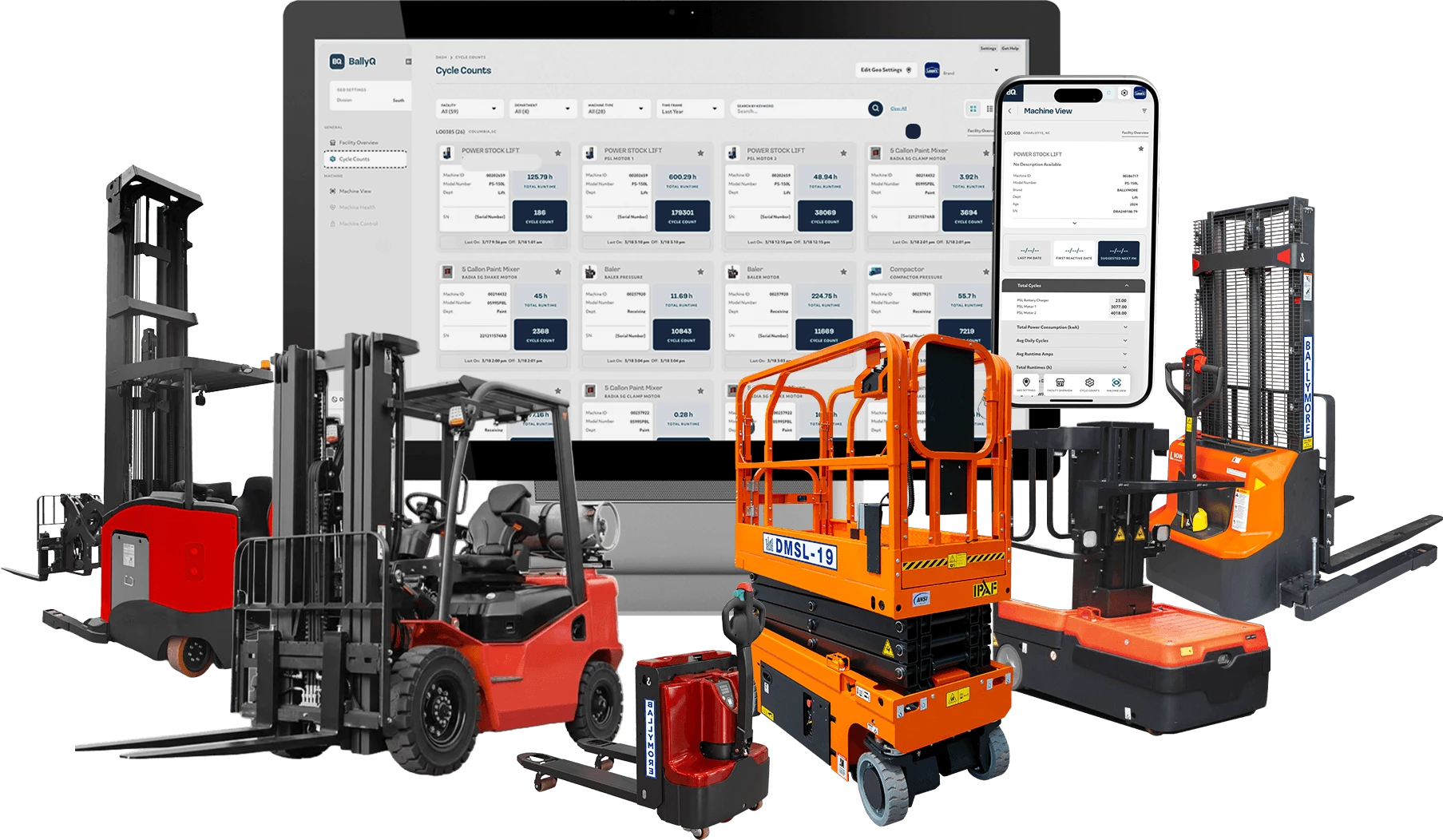
BallyQ gives data center facilities teams and EHS managers a single dashboard to track their access equipment fleet, stay ahead of inspection schedules, and generate audit-ready compliance reports without manual recordkeeping.

Services & Software
End-to-end commercial food equipment support from technicians trained and certified through CFESA, backed by data to drive better decisions across your entire fleet.
DOC Services has spent over three decades handling repair needs for the food service industry professionally and efficiently. As a member of CFESA, the Commercial Food Equipment Service Association, DOC's technicians have passed certification exams covering electricity, gas, steam, and refrigeration, and train directly with manufacturers to stay current on commercial food equipment. DOC supports hot side equipment including ovens, fryers, rotisseries, and steamers, cold side equipment such as reach-in coolers and walk-in refrigerators, and food preparation equipment like slicers and precision cutters. Expert installations are completed to manufacturer requirements and all governing codes.
More Service Solutions
First Call Fixes + Repairs
Trained technicians resolve issues on the first visit whenever possible, cutting down on repeat trips and extended downtime.
Performance Checks
Regular performance checks catch developing issues before they become a breakdown, keeping equipment running at its rated efficiency.
Preventative Maintenance
Scheduled maintenance is designed to extend equipment life and reduce the downtime and cost that come with reactive repairs.
Retrofits + Equipment Replacement
When a unit reaches the end of its service life, DOC handles retrofits and full equipment replacement to manufacturer specifications.
Battery Longevity Program
We maintain, repair, and replace the batteries in your powered pallet trucks and stackers, so your fleet never sits idle between shifts.
DOC Services documents every process for real-time visibility into:
Response Time
Total Completion Time
First Trip Completion
Average Invoice Cost
Equipment data on repair type, parts usage, age, and condition gives you clear insight into total cost of ownership, plus ongoing inventory and preventative maintenance support across every powered unit on the floor.
Battery Longevity Program
BALLYQ
BallyQ Secure safeguards your highest-value food and beverage assets, including proprietary formulations, high-value ingredients, and alcohol inventory in bonded storage areas, from theft and unauthorized access.
Built and supported by security specialists with food and beverage facility experience, BallyQ embeds into equipment and cabinet controllers so access to secure storage cannot happen without an authorized credential. IoT, GPS, and authentication technology track and secure every asset, and the backend ties into your existing inventory and asset-management systems for a single source of truth across the facility.
Learn About BallyQ
Comprehensive Asset Protection
BallyQ Secure safeguards your highest-value food and beverage assets, including proprietary formulations, high-value ingredients, and alcohol inventory in bonded storage, from theft and unauthorized access.
Seamless Integration
Embeds into equipment and cabinet controllers, so access to secure storage requires an authorized credential. Ties into your existing inventory and asset-management systems.
Cutting-Edge Technology
IoT, GPS, and authentication technology track and secure every asset. Unlike a passive GPS tag, BallyQ lets you disable hardware remotely.
Proactive Theft Prevention
Flags unauthorized movement, tampering, or removal in real time, down to individual ingredient totes and cases. Works on any equipment in the facility.
Dedicated Team of Experts
Built and supported by security specialists with food and beverage facility experience.
Brand Agnostic Program
Built to work on any powered equipment and accessible from any device, giving security teams one access control system across the entire processing floor.
BallyQ Brand Agnostic Program

Services & Software

Preventive maintenance, compliance inspections, and emergency repair for your full Ballymore equipment fleet — covered by a single nationwide service provider.
For data center operators managing equipment across multiple facilities, DOC Services eliminates the complexity of coordinating local vendors in every market. One service agreement, one point of contact, consistent documentation across every site.
Learn About DOC Services
Scheduled PM Programs
Preventive maintenance on defined intervals for ladders, lifts, and platforms.
Compliance Documentation
Inspection records and service reports suitable for OSHA audits and internal reviews.
Nationwide Coverage
Technician network covering all major US data center markets.
Single Point of Contact
One service agreement for multi-site operators across regions.
BALLYQ
Real-time visibility into equipment status, inspection records, compliance documentation, and safety program performance across all sites and assets.
BallyQ gives data center facilities teams and EHS managers a single dashboard to track their access equipment fleet, stay ahead of inspection schedules, and generate audit-ready compliance reports without manual recordkeeping.
Learn About BallyQ
Asset Tracking
Full inventory and inspection scheduling for every piece of access equipment across your facilities.
Compliance Reporting
Automated audit-ready reports for OSHA requirements and internal safety program reviews.
Multi-Site Dashboard
Consolidated fleet visibility for enterprise and hyperscale operators across all locations.
CMMS Integration
Connects with existing facilities management and CMMS platforms.
Engineered Access Solutions
Built Around Your Facility
Standard products do not always fit. Data center rack rows, raised floor configurations, UPS corridors, and cable tray systems all vary by facility. Ballymore's Engineered Access Solutions team works directly with your facilities team to design and fabricate custom platforms, rolling systems, and fixed access structures built to your exact specifications.
Talk to an EAS Engineer
Frequently Asked Questions
Common questions about access equipment, sanitation compliance, and safety for food and beverage processing, packaging, and distribution facilities.
What OSHA standards apply to ladders and elevated access in food and beverage facilities?
Food and beverage plants operate under OSHA's General Industry standards, primarily 29 CFR 1910. Portable and rolling ladders fall under OSHA 1910.23, which requires slip-resistant, uniformly spaced steps, a load rating of at least four times the maximum intended load, three points of contact while climbing or descending, and inspection before each day of use by a competent person, with defective ladders removed from service immediately. Walking-working surfaces, including elevated platforms around tanks and mixing equipment, fall under OSHA 1910.28, which requires fall protection at four feet or more above a lower level. Wet, sloped, or frequently washed-down floors add a slip hazard on top of the baseline standard, which is why non-marring, self-draining tread matters as much as the load rating itself in this environment. Ballymore stainless steel ladders and platforms are built to meet OSHA 1910.23 requirements for general industry use in washdown and processing environments.
What do NSF/ANSI 2 and 3-A Sanitary Standards mean for equipment used around food production?
NSF/ANSI 2 is the recognized standard covering minimum food protection and sanitation requirements for the materials, design, fabrication, and construction of food handling and processing equipment, including tables, counters, shelves, and sinks. The standard's focus is specifically on food zones, meaning surfaces that come into direct contact with food, versus splash zones and non-food zones that face a lower bar. 3-A Sanitary Standards cover a related but distinct area, the cleanability and inspection of dairy processing equipment specifically, and are the reason dairy plants commonly specify Tri-Clamp style sanitary fittings on tanks and piping. Access equipment like ladders and rolling platforms generally is not itself a food-contact surface and is not NSF-certified under 2, but operating in the same environment still means it needs to be built from a material that will not itself become a contamination risk. That is the practical reason Type 304 stainless steel with a bead-blasted finish is the standard specification for ladders and platforms used near food-contact equipment, even when the ladder itself falls outside NSF/ANSI 2's direct scope.
What sanitation requirements apply specifically to meat and poultry processing facilities?
Federally inspected meat, poultry, and egg products establishments operate under USDA FSIS regulations codified in 9 CFR Part 416, which require every facility to develop, implement, sign, and maintain a written Sanitation Standard Operating Procedure, commonly called an SSOP. The SSOP has to describe both pre-operational procedures, covering cleaning of food-contact surfaces before production starts, and operational procedures covering sanitation monitoring during the shift. What sets FSIS oversight apart from most other regulatory frameworks is that in-plant inspectors are physically present at each establishment daily, verifying both the sanitation procedures and HACCP system implementation and documenting any noncompliance on official Noncompliance Records. Repeated or serious noncompliance can escalate to a Notice of Intended Enforcement, and in the most serious cases, suspension of the establishment's grant of inspection. Access equipment used around processing lines needs to hold up to the same daily pre-operational and operational cleaning cycle the rest of the facility is built around, since equipment that cannot survive that cycle becomes a sanitation gap of its own.
What is FSMA's Intentional Adulteration Rule, and how does it affect equipment access control?
Since 2019, the FDA's Mitigation Strategies to Protect Food Against Intentional Adulteration Rule, part of the Food Safety Modernization Act, has required roughly 3,400 covered food companies operating about 9,800 facilities to maintain a written food defense plan. Unlike food safety rules that address known contamination risks, this rule is aimed specifically at preventing large-scale intentional adulteration, including insider threats, and requires a vulnerability assessment for every actionable process step in the facility. That assessment explicitly considers the degree of physical access to the product at each step, including physical barriers such as gates, railings, doors, lids, seals, and shields. This is where equipment-level access control becomes directly relevant rather than a general security nice-to-have. BallyQ is Ballymore's access control system, logging every operation of a powered piece of equipment by operator, time, and location, giving food safety and security teams a documented layer of physical access accountability at the equipment level that supports the broader food defense plan a covered facility is already required to maintain.
How do food manufacturing injury rates compare to other industries, and what does that mean for equipment selection?
Bureau of Labor Statistics data has consistently placed the food manufacturing sector's total recordable injury and illness rate at roughly 3.3 to 3.6 cases per 100 full-time workers in recent years, notably higher than the rate of about 2.7 across all manufacturing and 2.6 across all industry combined. Wet floors from washdown, improvised access to tanks and mixing vessels, and manual handling of ingredient drums and totes are recurring contributors specific to this sector rather than manufacturing in general. Non-marring, self-draining tread on ladders and platforms addresses the slip risk directly, while powered drum lifting and rotating equipment removes the manual tipping and lifting that leads to back injuries when ingredient containers are handled by hand. Selecting equipment built around these two specific risk factors, rather than generic industrial equipment, is one of the more direct ways a facility can move the needle on its own injury rate.
Does OSHA require certification to operate powered pallet trucks and other powered industrial trucks in a food processing plant?
Yes. Powered pallet trucks, stackers, and similar equipment are classified by OSHA as Powered Industrial Trucks and fall under the full training and certification requirements of 29 CFR 1910.178(l), regardless of facility type. Operators must complete formal instruction on safe operation and equipment-specific hazards, complete hands-on practical training, pass a documented performance evaluation, and be re-evaluated at least once every three years. A new evaluation is required sooner if an operator is observed operating unsafely, is involved in an incident or near miss, or is assigned to a different class of equipment. In a food or beverage facility, this applies just as much to equipment moving ingredient totes and finished pallets as it does to any warehouse forklift, and facility managers are responsible for keeping training records current for both direct employees and contractors.
How should multi-plant food and beverage manufacturers manage equipment compliance across facilities?
Manufacturers running multiple registered facilities face a compliance challenge that a single-site operation does not: FSMA's food defense requirements, USDA FSIS sanitation oversight where applicable, and OSHA inspections all apply independently at each location, and a documentation gap at any one facility carries the same exposure as a gap at the flagship plant. The required documentation spans pre-use inspection records for ladders and platforms, preventive maintenance records, powered industrial truck operator certification, and equipment access logs that support each facility's food defense plan. BallyQ gives facilities and food safety teams centralized visibility into equipment access across every location, with inspection scheduling and audit-ready service records. DOC Services complements that with scheduled preventive maintenance programs and standardized documentation across facilities under a single agreement. For a manufacturer running several plants, that combination removes the compliance gaps that come from coordinating separate local vendors and paper trails at every site.
What access equipment is recommended for safely reaching tanks, mixers, and refrigerated trailer units?
Getting an operator safely to the top of a tank or mixing vessel for inspection, sampling, or cleaning is one of the more frequent elevated-access tasks on a processing floor, and it needs to happen the same way every time rather than through improvised staging. A stainless steel rolling ladder with non-marring casters and a bead-blasted finish gives operators repeatable, washdown-rated access to the same elevated point without a fixed structure taking up floor space permanently. For overhead piping, valves, and mixing equipment in tight aisles, a compact drivable scissor lift can reach where a standard scissor lift cannot maneuver. Refrigerated trucks and trailers present a related but distinct challenge, since maintaining the reefer unit itself requires safe access to equipment mounted well above ground level on the front of the vehicle. A rolling work platform built specifically for that application, with an adjustable platform height, dual-sided ladder access, and outriggers for stability, is purpose-built for that job rather than a generic ladder pressed into service.
What is the safest way to move ingredient drums and totes in a food or beverage facility?
Oils, syrups, brine, and other bulk liquid ingredients commonly arrive in 55-gallon drums that weigh well over 400 lbs when full, and manually tipping or rolling a drum to pour or reposition it is exactly the kind of task OSHA's general material handling guidance flags as needing mechanical assistance rather than manual effort. A powered drum lift and rotator lifts, tilts, and rotates the drum under power for controlled positioning and pouring, removing both the injury risk and the spill risk that come with tipping a drum by hand. For moving heavy totes and ingredient containers into position at a mixing station or fill line, a fully powered ball conveyor transfer table lets an operator slide a load into place without lifting it at all. A minimum two-person team is good practice for any load over 50 lbs, consistent with general OSHA material handling guidance, regardless of which piece of equipment is doing the lifting.
How often should washdown and stainless steel access equipment be inspected and maintained?
OSHA 1910.23 requires every ladder to be inspected before each day of use by a competent person, with any structurally defective ladder immediately removed from service and tagged out. Powered industrial trucks fall under OSHA 1910.178, which requires examination before each shift and after any event that may have caused damage. In a washdown environment, that daily check needs to specifically include casters, fasteners, and welds, since even stainless equipment can develop corrosion or caster failure faster than the same equipment would in a dry facility if sanitizing chemicals are not fully rinsed after each cycle. Beyond that daily pre-use check, equipment on a high-cycle processing floor should sit on a documented preventive maintenance schedule, with quarterly or semi-annual PM visits a reasonable baseline depending on actual washdown frequency. DOC Services provides scheduled PM programs covering Ballymore access and material handling equipment across facilities under a single service agreement, with documentation suitable for both internal sanitation audits and regulatory inspections.

Frequently Asked Questions

What OSHA standards apply to ladders and access equipment in data centers?

OSHA 29 CFR 1910.23 governs portable ladders in general industry, including rolling safety ladders used in data center rack rooms. ANSI A14.7 is the specific standard for rolling safety ladders. OSHA 1910.29 covers fall protection systems on elevated platforms. For data centers under active construction or fit-out, the construction standards under 29 CFR 1926 apply instead.

What fall protection is required when working at heights in a data center?

Under OSHA 29 CFR 1910.28, fall protection is required at heights of 4 feet or more in general industry. For elevated work platforms, guardrail systems with self-closing gates are the preferred engineering control as they protect workers passively without requiring PPE. Ballymore work platforms include full perimeter guardrails and self-closing safety gates as standard.

Will standard ladder casters damage raised floor tiles in a data center?

Yes. Hard polyurethane or steel casters can scratch and crack raised access floor tiles, which are costly to replace and disruptive to airflow management. Ballymore Hybrid Rolling Ladders use non-marring rubber casters designed specifically for raised floor environments. The weight-actuated lockstep also prevents the ladder from drifting under load.

Can Ballymore build custom platforms for non-standard rack configurations?

Yes. Ballymore's Engineered Access Solutions team designs and fabricates custom platforms, narrow-aisle rolling systems, and fixed access structures for facilities where standard products don't fit. Common projects include custom-width platforms for non-standard aisle widths and UPS room platforms built to exact dimensions. Lead times are typically 4 to 8 weeks from drawing approval.

What is DOC Services and what does it cover for data center operators?

DOC Services is Ballymore's nationwide field service program covering preventive maintenance, compliance inspections, and repair for the full Ballymore product family. For operators managing equipment across multiple facilities, DOC eliminates the need to coordinate local vendors in each market. Service agreements include scheduled on-site inspections, documented service reports, and OSHA compliance verification through a single point of contact.

What is BallyQ and how does it help data center safety teams?

BallyQ is Ballymore's safety intelligence software that gives facilities and EHS teams full visibility into their access equipment fleet. It tracks asset inventory, inspection schedules, service history, and compliance status across all sites. For hyperscale and multi-site operators, BallyQ provides a consolidated dashboard and generates audit-ready OSHA compliance reports automatically, replacing manual spreadsheet recordkeeping.

What weight capacity do I need for a data center rolling ladder?

Standard rolling ladders are rated at 350 lbs. However, data center technicians often climb while carrying tools and components, so capacity matters. Ballymore's Hybrid series is rated at 450 lbs and is the most commonly specified model for rack-room environments. The Work Titan heavy-duty series is rated at 800 lbs for facilities requiring additional capacity.