










Manufacturing


When Downtime Isn't an Option, Access Matters
One wrong move in a rack room costs more than the equipment. Ballymore's access solutions are built around the unique constraints of data center environments, including tight aisles, raised floors, and zero tolerance for disruption
Ballymore Family of Brands
Manufacturing
Safe, engineered access and material handling solutions for production floors, assembly lines, and maintenance operations across every stage of the manufacturing process.

Challenges & Solutions

01
Safe elevated access on active production floors
Workers need reliable access to shelving, machinery, and overhead areas without disrupting line flow or creating fall hazards in high-traffic zones.
02
Moving heavy loads between workstations
Manually transporting heavy pallets and materials between workstations creates injury risk and slows throughput on time-sensitive production schedules.
03
Accessing machinery for maintenance
Large-scale machinery and overhead systems require stable, compliant work platforms that fit the specific dimensions of each installation.
04
Ergonomic positioning and work-at-height
Repetitive bending and lifting at fixed work heights causes fatigue and injury over time, driving up workers compensation costs on assembly and packaging lines.
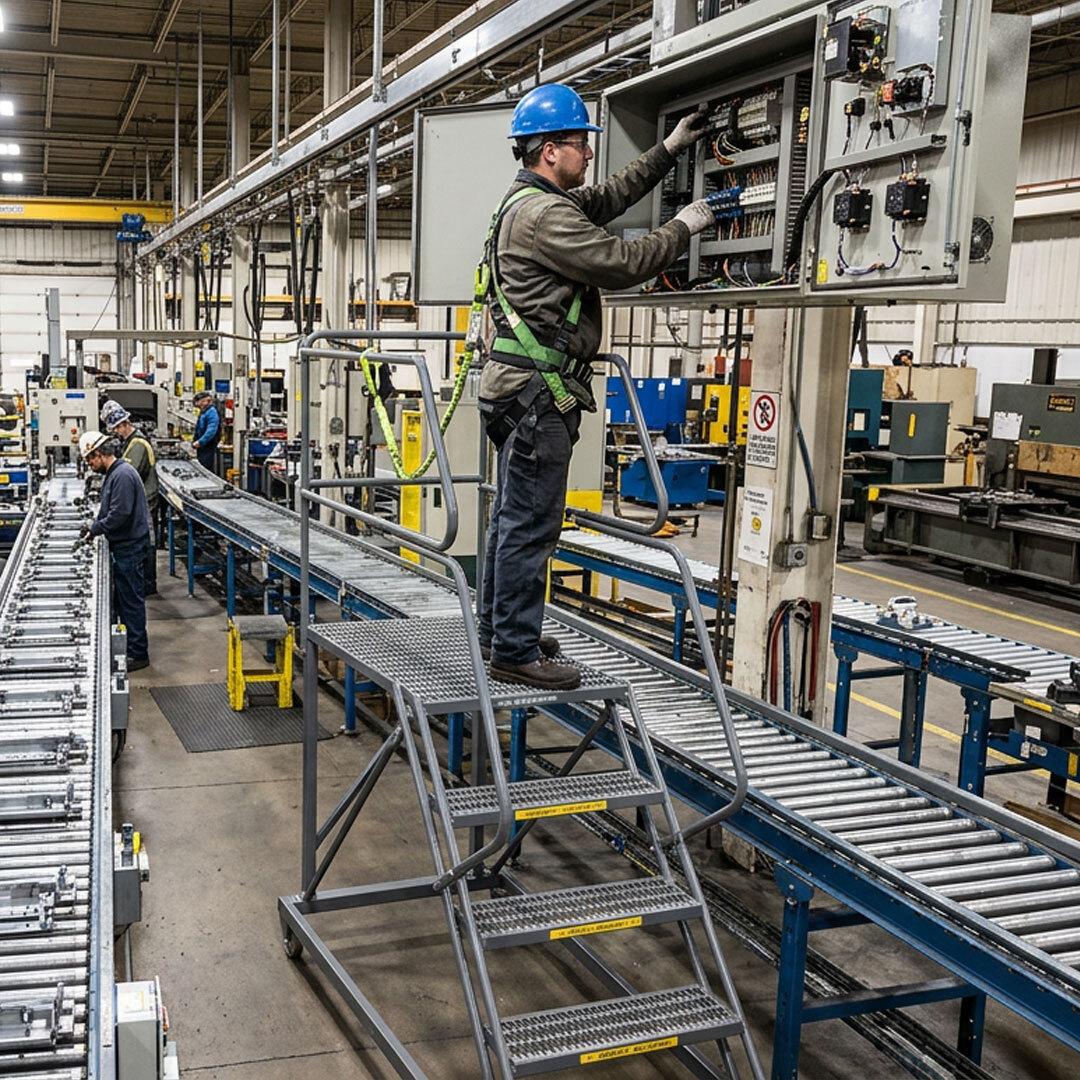
Rolling Safety Ladder on manufacturing floor
Ballymore Safety Products
Rolling Safety Ladder
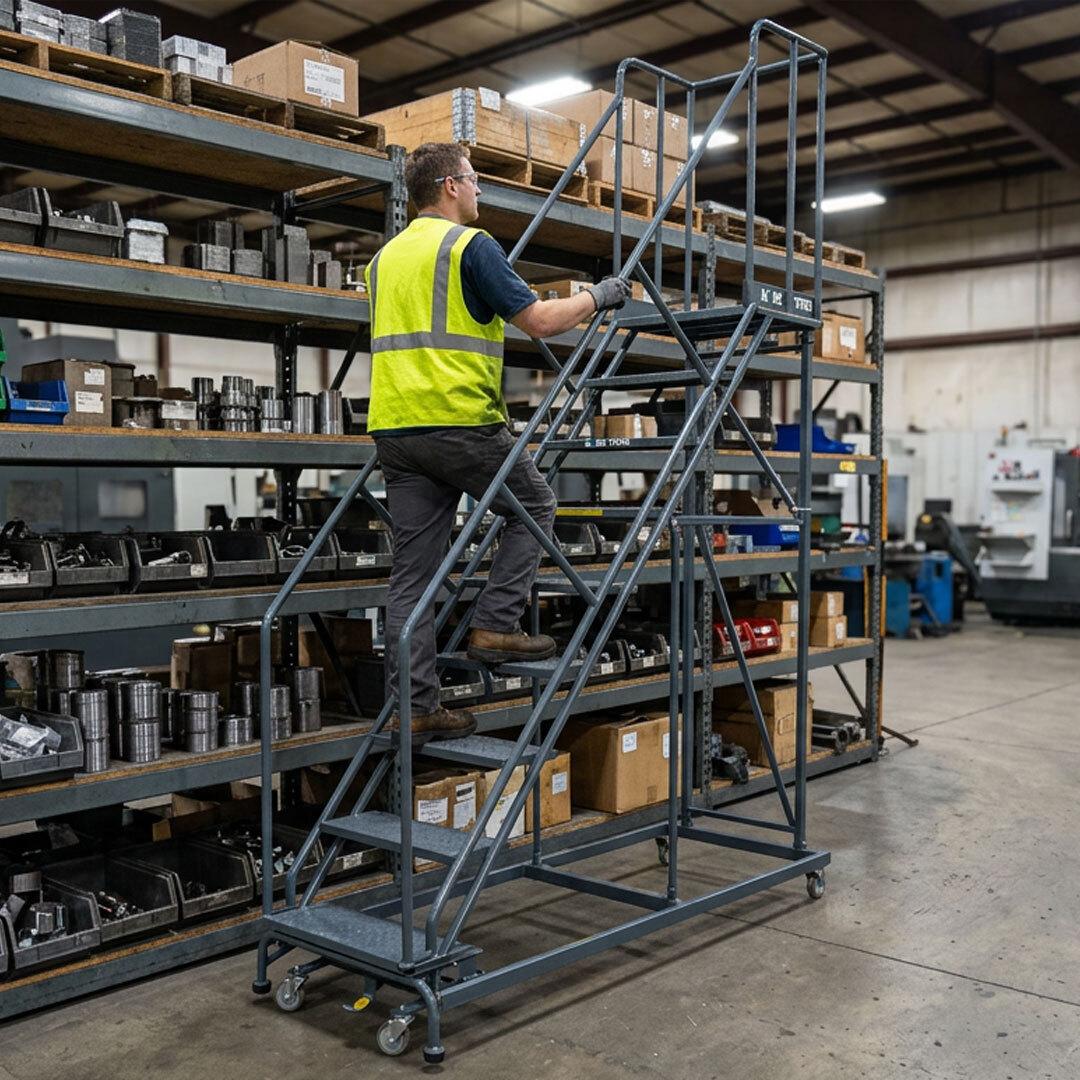
Ballymore rolling safety ladders provide OSHA and ANSI-compliant elevated access with serrated slip-resistant steps, spring-loaded locking casters, and handrail systems designed for repeated daily use on industrial floors.
View Product
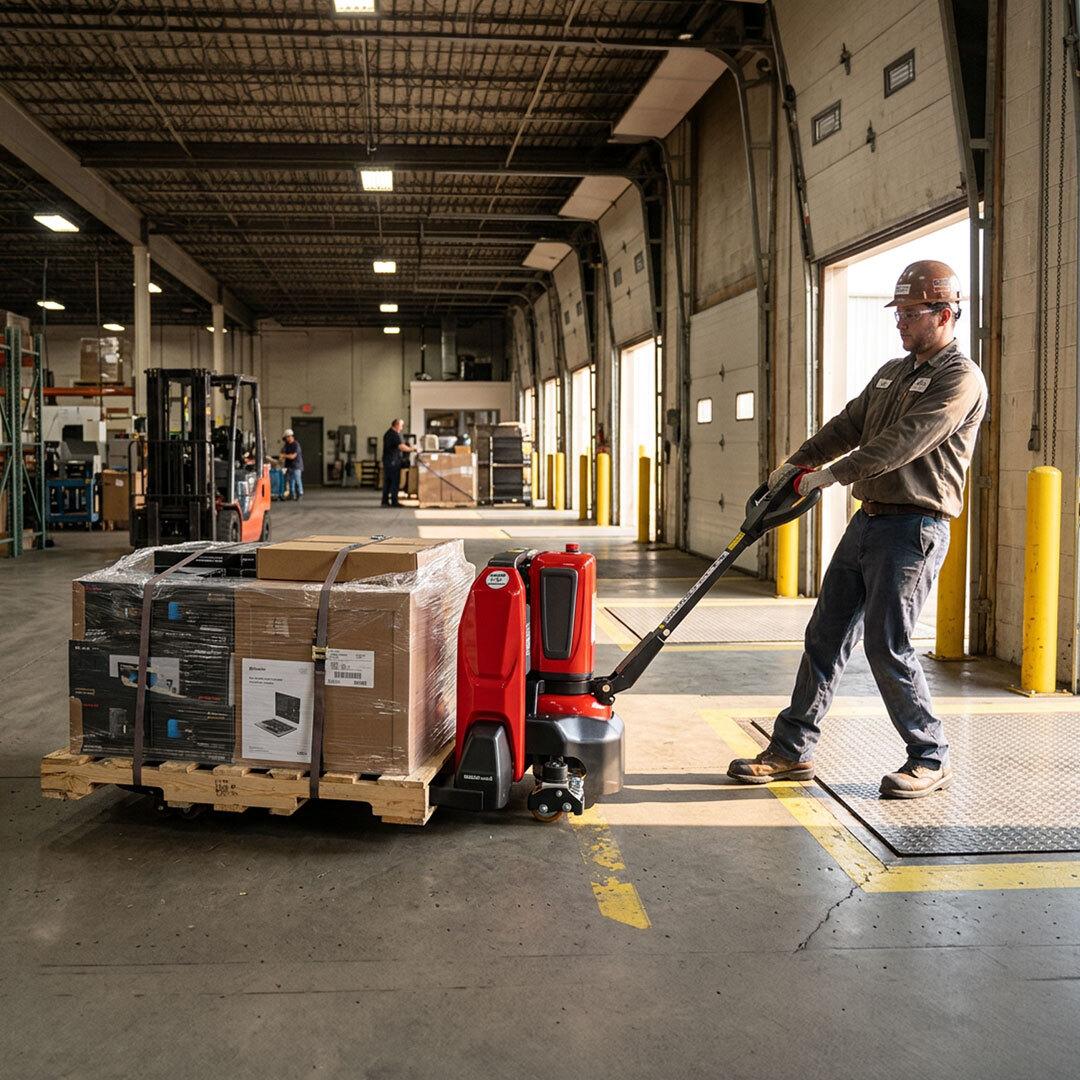
Powered Pallet Jack on manufacturing floor
Ballymore Safety Products
Powered Pallet Jack
Electric powered pallet jacks reduce manual handling strain, enabling one operator to move loads efficiently across plant floors. Rider and walkie configurations suit a wide range of facility layouts and load requirements.
View Product
Work Platform on manufacturing floor
EAS / Ballymore Safety Products
Work Platform
Ballymore fixed and mobile work platforms, backed by EAS engineered custom solutions, provide compliant elevated work areas tailored to machine dimensions, access angles, and facility footprint requirements.
View Product
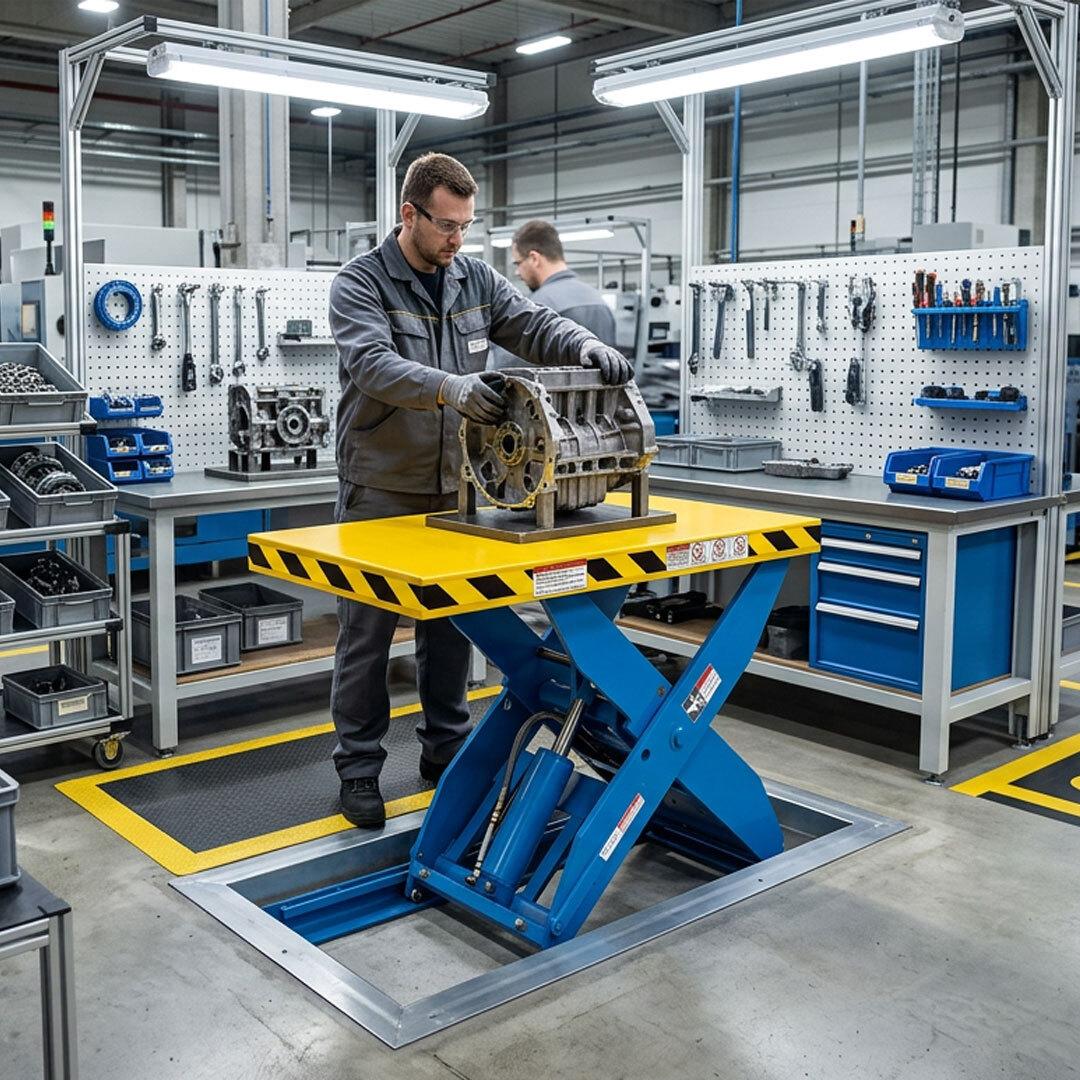
Scissor Lift Table on manufacturing floor
Lift Products
Scissor Lift Table
Scissor lift tables bring work to the optimal ergonomic height for each task and operator, reducing strain on assembly, kitting, and packaging lines. Electric and manual configurations available across a wide range of load capacities.
View Product

Common Use Cases

01
Assembly Line Access
Workers on active assembly lines need fast-repositioning elevated access to overhead conveyors, fixtures, and machinery without disrupting line flow or creating fall hazards in high-traffic production zones.
02
Maintenance and MRO
Maintenance technicians servicing large-scale machinery, overhead systems, and process equipment need stable, compliant work platforms that fit the specific dimensions and access angles of each installation.
03
Receiving and Loading Docks
Inbound material handling at dock doors involves moving heavy pallets and loads through tight staging areas. Powered pallet jacks and stackers reduce injury risk and keep receiving operations moving at pace with production schedules.
04
Paint and Finishing Operations
Paint booths and finishing lines require non-sparking, chemically resistant access equipment that meets safety requirements for hazardous environments without compromising worker positioning or production throughput.
05
Quality Control and Inspection
QC technicians inspecting large assemblies, finished goods, and elevated work areas need stable access that keeps them safely positioned at the right height without improvised solutions that introduce compliance risk.
06
Kitting, Staging and Packaging
Repetitive kitting, staging, and packaging tasks at fixed work heights drive fatigue and injury over time. Scissor lift tables and ergonomic positioning equipment bring the work to the right height for each operator and each task.
Built for the Data Center Floor
What facilities operators and EHS teams gain, and the equipment behind it.
Uptime
Protect Live Equipment
A populated rack never gets muscled into place next to live gear, so a routine job does not become an incident. The right access equipment keeps maintenance predictable and downtime off the schedule.
Server & Rack Lift
Speed to Deployment
Compress the Schedule
An existing lift that fits most racks with little to no modification, and ships fast so capacity moves now. Shorter lead times mean fit-out timelines stay on track regardless of facility size.
Existing Lift + Fast Ship
Safety
Personnel and Equipment
AI servers now regularly exceed 300 lbs. Powered lifts, pallet jacks, and stackers take that load off people's hands and keep both personnel and equipment protected during installation and maintenance.
Powered Lifts, Jacks & Stackers
Security
Control Who Operates
Access control built directly into the equipment. BallyQ software, keypad entry, and physical key locks restrict operation to authorized personnel, a critical requirement in high-security data center environments.
BallyQ, Keypad & Key Locks
Productivity
Do More With Fewer Hands
Powered equipment lets one worker move and place loads that used to take a crew, so the same team covers more racks, more floors, and more shifts without adding headcount.
Powered Jacks, Stackers & Tugs
Customization
Built to Your Need
When a standard unit does not fit the application, Ballymore's in-house engineering team designs and manufactures a turnkey solution built specifically for your facility, your aisle width, and your load.
In-House Engineering & Turnkey
Built for the Data Center Floor
What facilities operators and EHS teams gain, and the equipment behind it.
Uptime
Protect Live Equipment
A populated rack never gets muscled into place next to live gear, so a routine job does not become an incident. The right access equipment keeps maintenance predictable and downtime off the schedule.
Server & Rack Lift
Case Study
Live Rack Access Without Incident
A hyperscale operator running 24/7 maintenance needed a way to access populated racks in narrow hot aisles without risking adjacent live equipment. The Hybrid Rolling Ladder's non-marring casters and Lift Assist Lockstep meant technicians could reposition safely between racks without a second person or a shutdown window.
View Data Center Equipment
Speed to Deployment
Compress the Schedule
An existing lift that fits most racks with little to no modification, and ships fast so capacity moves now. Shorter lead times mean fit-out timelines stay on track regardless of facility size.
Existing Lift + Fast Ship
Why It Matters
Ship-Ready Equipment, No Modification Required
Data center fit-outs run on tight schedules. Ballymore's standard rack lifts and rolling ladders are designed to fit most rack row configurations without custom fabrication. Most orders ship within standard lead times so your deployment timeline stays on track.
Request a Quote
Safety
Personnel and Equipment
AI servers now regularly exceed 300 lbs. Powered lifts, pallet jacks, and stackers take that load off people's hands and keep both personnel and equipment protected during installation and maintenance.
Powered Lifts, Jacks & Stackers
OSHA Compliance
OSHA 1910-Compliant Access for Data Center Environments
AI server hardware now regularly exceeds 300 lbs per unit. Manual handling at that weight is both a safety violation and an equipment risk. Ballymore's powered lifts, pallet jacks, and stackers are OSHA 1910-compliant and built specifically for raised floor environments where standard industrial equipment cannot operate safely.
View Lift Safety Resources
Security
Control Who Operates
Access control built directly into the equipment. BallyQ software, keypad entry, and physical key locks restrict operation to authorized personnel, a critical requirement in high-security data center environments.
BallyQ, Keypad & Key Locks
BallyQ Access Control
Know Who Operated the Equipment and When
BallyQ is Ballymore's proprietary access control system. It logs every operation by operator, time, and location. Combined with keypad entry and physical key locks, it gives data center security teams a complete audit trail for every piece of powered equipment on the floor.
Learn About BallyQ
Productivity
Do More With Fewer Hands
Powered equipment lets one worker move and place loads that used to take a crew, so the same team covers more racks, more floors, and more shifts without adding headcount.
Powered Jacks, Stackers & Tugs
Labor Impact
One Operator. One Shift. More Ground Covered.
A single operator with a powered pallet jack or tug can move battery pallets, server hardware, and rack components that previously required two or three people. Across a full fit-out or maintenance cycle, that difference compounds into significant labor cost savings and faster project completion.
View Products
Customization
Built to Your Need
When a standard unit does not fit the application, Ballymore's in-house engineering team designs and manufactures a turnkey solution built specifically for your facility, your aisle width, and your load.
In-House Engineering & Turnkey
Custom Build Example
Custom Server Mover for a Hyperscale Operator
A major data center operator needed a purpose-built server mover that could navigate 24-inch hot aisles, handle loads up to 500 lbs, and meet their internal safety certification requirements. Ballymore's EAS engineering team designed, fabricated, and delivered a turnkey solution in 8 weeks. No off-the-shelf product existed that could do the job.
Talk to an EAS Engineer
Ballymore Safety Group
Built for the Manufacturing Floor
What plant operators gain, and the equipment behind it
Safety Compliance
OSHA and ANSI Aligned
Every ladder, lift, and platform ships compliant so your facility audit does not turn into a corrective action backlog.
Ladders, Lifts & Platforms
Compliance
OSHA 1910 and ANSI Compliant Out of the Box
Ballymore rolling ladders, work platforms, and lift tables are designed and manufactured to meet OSHA 1910 and applicable ANSI standards. That means no field modifications required to pass inspection, and a clear paper trail for your EHS team when auditors arrive on the plant floor.
View Compliant Equipment
Uptime
Minimize Line Stoppages
Equipment that fails on the floor stops production. Ballymore builds for industrial duty cycles, not light commercial use.
Industrial-Grade Construction
Durability
Designed for Daily Industrial Use
A rolling ladder or lift table used dozens of times a day on a production floor needs to be built to a different standard than equipment used occasionally in a warehouse. Ballymore products are engineered for high-cycle industrial environments, with welded steel construction, heavy-duty casters, and components rated for continuous use.
View Products
Ergonomics
Reduce Worker Fatigue
Lift tables, tilt carts, and adjustable platforms bring the work to the worker instead of forcing repetitive strain postures.
Lift Tables, Tilt Carts & Platforms
Ergonomic Impact
Less Bending. Less Reaching. Fewer Injuries.
Musculoskeletal injuries are among the most common and costly on manufacturing floors. Scissor lift tables, tilt carts, and height-adjustable platforms let operators work at the right height for every task, reducing the repetitive bending, reaching, and lifting that drives up injury rates and workers compensation costs over time.
View Ergonomic Solutions
Throughput
Faster Material Flow
Powered pallet jacks and stackers move loads between workstations faster, with fewer people, keeping the line fed.
Powered Jacks & Stackers
Labor Impact
One Operator Moving What Used to Take Three
A single operator with a powered pallet jack or electric stacker can move material loads between workstations, staging areas, and dock doors that previously required multiple people. Across a full shift that difference compounds into significant labor savings and faster cycle times, without adding headcount.
View Material Handling
Total Cost
Long Service Life
Heavy-gauge steel construction and commercial-grade components mean fewer replacements, lower maintenance costs, and a longer asset life on the plant floor.
Built for Long Service Life
Total Cost of Ownership
Built to Last Decades, Not Seasons
Ballymore products are built from heavy-gauge steel with commercial-grade welding and finishing. The upfront cost is higher than lower-grade alternatives, but the total cost of ownership over a 10 to 20 year service life is significantly lower. Fewer replacements, lower maintenance, and parts availability from domestic stock.
Talk to a Specialist
Customization
Built to Your Plant
When a standard unit does not fit the machine, the aisle, or the process, EAS engineers and builds a turnkey solution.
EAS In-House Engineering
Custom Build Capability
Engineered Access Solutions for Any Machine
EAS designs and manufactures custom platforms, crossovers, and multi-level access systems around your exact production layout, conveyor configuration, and machine geometry. Every build is OSHA-compliant and delivered ready to install.
Multi-Platform Access System
H-shaped platform connecting conveyor hoppers at varying heights. Operators move between stations without interrupting material flow.
Press Access Platform
Pinned guardrail platform engineered for operator reach around press equipment. On-site assessment ensures a precise fit in tight production spaces.
Conveyor Crossover
Conveyor Crossover
Elevated bridge passage over active conveyors with two entry and exit points. Workers cross between areas without disrupting material flow.
Layout
Custom
Fit to your floor
Materials
Steel/Al
Per application
Compliance
OSHA
Engineered to spec
Support
Direct
In-house engineering
View EAS Manufacturing Projects
Ladders · Lift Tables · Work Platforms · Pallet Jacks · Stackers · Drum Handlers · Tilt Carts · Custom EAS
Serviced in All 50 States

Services & Software

Preventive maintenance, compliance inspections, and emergency repair for your full Ballymore equipment fleet, covered by a single nationwide service provider.
For manufacturing operators managing equipment across multiple facilities and shifts, DOC Services eliminates the complexity of coordinating local vendors in every market. One service agreement, one point of contact, and consistent compliance documentation across every plant.
Learn About DOC Services
Scheduled PM Programs
Preventive maintenance on defined intervals for ladders, lifts, platforms, and material handling equipment.
Compliance Documentation
Inspection records and service reports suitable for OSHA audits and internal EHS program reviews.
Nationwide Coverage
Technician network servicing manufacturing facilities across all major US markets.
Single Point of Contact
One service agreement for multi-plant operators managing equipment across regions.
BALLYQ
Real-time visibility into equipment status, inspection records, compliance documentation, and safety program performance across all plants and assets.
BallyQ gives manufacturing EHS managers and facilities teams a single dashboard to track their access and material handling equipment fleet, stay ahead of inspection schedules, and generate audit-ready compliance reports without manual recordkeeping across multiple plants and shifts.
Learn About BallyQ
Asset Tracking
Full inventory and inspection scheduling for every piece of access and handling equipment across your facilities.
Compliance Reporting
Automated audit-ready reports for OSHA requirements and internal safety program reviews.
Multi-Plant Dashboard
Consolidated fleet visibility for multi-site manufacturing operators across all locations and shifts.
CMMS Integration
Connects with existing facilities management and CMMS platforms used in manufacturing environments.

Common Use Cases

Hyperscale Campus Operations

Managing rack access and equipment movement across millions of square feet requires standardized, durable access solutions that perform consistently across every hall and building.

Colocation Rack Maintenance

Colo technicians working across multi-tenant environments need fast-repositioning access equipment that keeps pace with high-frequency hot-swap, cabling, and rack maintenance demands.

Enterprise Server Room Access

In-house IT and facilities teams need OSHA-compliant access equipment that works safely on raised access floors without specialized training or disrupting day-to-day operations.

UPS & Battery Infrastructure

Scheduled UPS battery replacements require moving heavy loads through tight mechanical corridors safely. Proper material handling equipment eliminates the manual handling injuries during maintenance cycles.


Services & Software

Preventive maintenance, compliance inspections, and emergency repair for your full Ballymore equipment fleet — covered by a single nationwide service provider.

For data center operators managing equipment across multiple facilities, DOC Services eliminates the complexity of coordinating local vendors in every market. One service agreement, one point of contact, consistent documentation across every site.

Scheduled PM Programs

Preventive maintenance on defined intervals for ladders, lifts, and platforms.

Compliance Documents

Inspection records and service reports suitable for OSHA audits and internal reviews.

Nationwide Coverage

Technician network covering all major US data center markets.

Single Point of Contact

One service agreement for multi-site operators across regions.


Asset Tracking

Full inventory and inspection scheduling for every piece of access equipment across your facilities.

Compliance Reporting

Automated audit-ready reports for OSHA requirements and internal safety program reviews.

Multi-Site Dashboard

Consolidated fleet visibility for enterprise and hyperscale operators across all locations.

CMMS Integration

Connects with existing facilities management and CMMS platforms.

Real-time visibility into equipment status, inspection records, compliance documentation, and safety program performance across all sites and assets.

BallyQ gives data center facilities teams and EHS managers a single dashboard to track their access equipment fleet, stay ahead of inspection schedules, and generate audit-ready compliance reports without manual recordkeeping.

Manufacturing Safety
Frequently Asked Questions
Common questions about access equipment, material handling, and safety compliance for manufacturing facilities.
What OSHA standards apply to ladders and elevated access equipment in manufacturing facilities?
Ladders in general industry manufacturing environments are governed by OSHA 29 CFR 1910.23, which covers portable ladders, fixed ladders, and step stools. Key requirements include inspecting ladders before each use, loading ladders only within their rated capacity, and ensuring rungs and steps are slip-resistant. For fixed ladders over 24 feet installed after November 19, 2018, OSHA requires a personal fall arrest system or ladder safety system in place of a cage. Work platforms and elevated work surfaces fall under OSHA 1910.28 and 1910.29, which govern fall protection for walking-working surfaces. Ballymore rolling safety ladders are designed and manufactured to meet 1910.23 requirements for general industry use.
How often should industrial ladders and lift tables be inspected in a manufacturing environment?
OSHA 1910.23 requires that ladders be inspected before each day of use by a competent person, defined as someone capable of identifying hazards and authorized to take corrective action. Any ladder found to have structural defects must be immediately tagged out of service and removed until repaired or replaced. For lift tables and scissor lifts, ANSI MH29.1 requires a documented inspection and maintenance program with regular intervals based on frequency of use. High-cycle manufacturing environments typically warrant more frequent inspection schedules than those specified as minimums. DOC Services can establish and manage a compliant preventive maintenance program across your facility fleet.
What is the difference between a rolling safety ladder and a standard stepladder for plant floor use?
A standard stepladder is a portable, self-supporting ladder that must be fully opened and placed on a stable surface before use. It is not designed for repeated repositioning on an active production floor and does not provide a fixed platform for sustained work at height. A rolling safety ladder is designed specifically for industrial environments: it includes spring-loaded locking casters that disengage under load to lock the ladder in place, a fixed platform with guardrails for hands-free work at height, and serrated slip-resistant steps. Rolling safety ladders are built to OSHA 1910.23 requirements and are the appropriate choice for repeated access tasks on plant floors, storage areas, and assembly lines where workers need to ascend and descend frequently throughout a shift.
How do scissor lift tables reduce workplace injuries in manufacturing and assembly operations?
Overexertion injuries are among the most common and costly in manufacturing environments. According to the Liberty Mutual Workplace Safety Index, overexertion costs U.S. businesses over $12 billion annually in direct workers compensation expenses. Scissor lift tables address this by raising loads or work surfaces to the optimal ergonomic height for each task and operator, eliminating repetitive bending, reaching, and lifting at fixed heights. On assembly, kitting, and packaging lines, this reduces cumulative strain on the back and shoulders, which are the primary sources of musculoskeletal disorders in manufacturing. Lift tables rated to ANSI MH29.1 provide a documented safety standard and minimum design criteria for industrial use.
When does a manufacturing facility need a custom engineered access platform instead of a standard ladder or work platform?
Standard ladders and work platforms cover most elevated access needs on a plant floor. A custom engineered solution is typically required when the access geometry, machine footprint, or facility layout cannot be safely or practically served by a stock product. Common triggers include: access to large-scale machinery at multiple heights or angles, overhead conveyor systems requiring a stable standing surface at a specific elevation, confined or irregular floor spaces that prevent standard platform placement, or regulatory requirements for guardrails and handrails at a specific height. Ballymore's EAS (Engineered Access Solutions) division designs and manufactures custom work platforms, machine access stairs, and multi-level access systems to OSHA standards for exactly these situations. Contact us to discuss your application.
What material handling equipment is recommended for moving heavy loads on a production floor?
The right equipment depends on load weight, travel distance, floor surface, and aisle width. For pallet-sized loads up to several thousand pounds, electric powered pallet jacks (walkie or rider configurations) are the most common solution and significantly reduce manual handling injury risk compared to manual jacks. For loads that need to be elevated as well as transported, electric stackers or combination lift-and-transport units are appropriate. For heavy or irregularly shaped components between workstations, tuggers and material carts may be more suitable. OSHA does not specify a maximum manual handling weight limit, but NIOSH guidelines and ergonomic best practices strongly recommend powered equipment for loads over 50 lbs when handled repeatedly. Ballymore offers a range of powered material handling equipment suited to manufacturing floor conditions.
How does BallyQ help manufacturing EHS managers track equipment compliance across multiple plants?
BallyQ is Ballymore Safety Group's equipment management platform that gives EHS managers and facilities teams a centralized dashboard to track their access and material handling equipment fleet across multiple locations. Key capabilities include asset inventory management, automated inspection scheduling based on regulatory intervals, service record tracking, and audit-ready compliance reporting for OSHA requirements. For multi-plant manufacturing operators, this eliminates the manual recordkeeping burden and reduces the risk of an inspection interval being missed at a remote facility. BallyQ can also integrate with existing CMMS platforms used in manufacturing environments.
What should a manufacturing facility look for when selecting a safety ladder for an active production floor?
Several factors should guide ladder selection for production floor use. Duty rating: ladders are classified Type III through Type IAA based on load capacity; industrial environments require Type I (250 lbs) or Type IA (300 lbs) minimum. Platform height: match the required access height to the ladder's working platform height, not the top step. Caster and locking mechanism: spring-loaded locking casters are essential for production floors where the ladder will be repositioned frequently. Step surface: serrated or perforated steps provide slip resistance in environments where oil, coolant, or debris may be present on footwear. Handrail configuration: OSHA 1910.23 requires specific handrail heights for platform ladders used as work platforms. Material: steel for heavy-duty industrial environments; aluminum where weight savings are a priority and corrosive materials are not present.