










Rolling Ladder vs. Lift: Which Is Better for Your Facility?
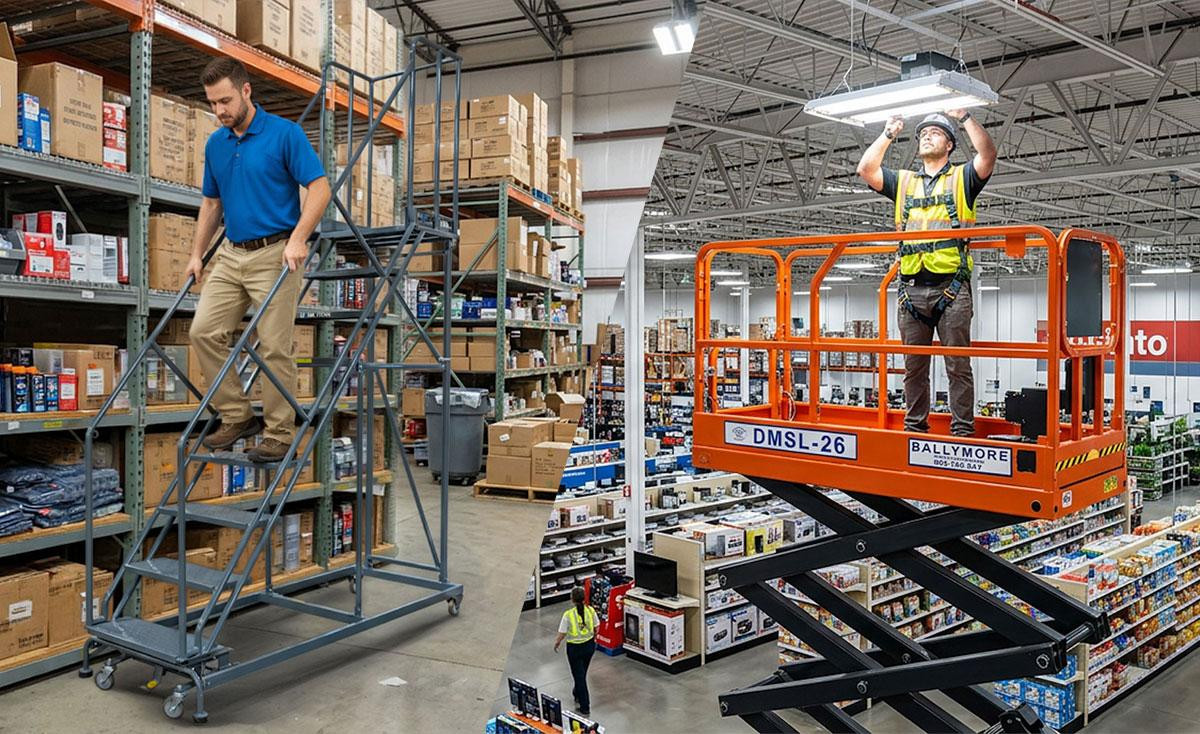
Which is better, a rolling ladder or a lift? Neither is better for every job. A rolling ladder is often the right choice for quick, light access at moderate heights, while a lift is usually better for higher reach, repeated stocking and picking, or longer work at height. The right choice depends on the task, working height, load, frequency of use, floor conditions, and available space.
This guide compares rolling ladders and lifts to help you determine which access solution makes sense for your facility. We will look at rolling ladders, scissor lifts, vertical mast lifts, merchandise lifts, maintenance lifts, Power Stockers, and personnel lifts, along with the safety and operating factors that should influence your decision.
Rolling Ladder vs. Lift at a Glance
| Factor | Rolling Ladder | Lift |
|---|---|---|
| Best for | Quick, light access at moderate heights | Higher reach, repeated stocking and picking, and longer work at height |
| Working height | Generally up to 5 to 6 feet above the top step or platform for convenient working height | Varies significantly by lift type and model |
| Load capacity | Varies by material, with Ballymore options ranging from 350 to 800 lb. | Varies by model, application, and lift type |
| Power | No power required | Battery, electric, or hydraulic depending on model |
| Movement | Rolled into position by the user | Push-around or drivable depending on model |
| Handling stock | Items are carried by the worker | Worker and materials can be raised together |
| Best starting point | Short-duration access and routine stocking | Higher, longer, heavier, or more repetitive work |
When Should You Use a Rolling Ladder Instead of a Lift?
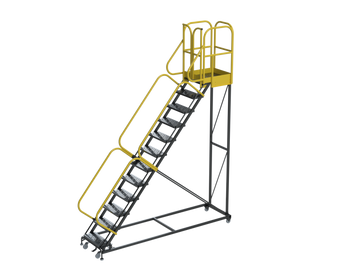
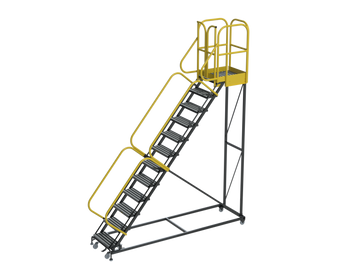
Use a rolling ladder when the work is relatively low, brief, and repetitive, and when it takes place on a smooth, level floor where the ladder can be safely positioned. Rolling ladders are commonly used in warehouses, stockrooms, retail backrooms, maintenance areas, and industrial facilities.
The biggest advantage of a rolling ladder is simplicity. A worker can roll the ladder into position, engage the appropriate locking mechanism, climb, complete the task, and move on. There is no battery to charge or powered control system to operate.
Rolling ladders are particularly useful when employees need frequent access to shelves, bins, parts, cartons, or equipment that is above comfortable ground-level reach but does not justify a powered lift.
Common Rolling Ladder Applications
- Stock picking and replenishment: Reach cartons, bins, parts, and other inventory stored above ground-level access.
- Inventory checks: Read labels, scan barcodes, count inventory, or visually inspect products.
- Light maintenance: Access panels, fixtures, signs, and other equipment when the work is relatively brief.
- Retail and backroom operations: Replenish displays and retrieve merchandise from upper storage areas.
- Warehouse access: Reach elevated shelving without bringing powered equipment into every aisle.
How High Can You Safely Work From a Rolling Ladder?
Working height is an important consideration when selecting a rolling ladder. Ballymore's ladder selection guidance states that the maximum convenient working height is generally about 5 to 6 feet above the top step or platform.
Ceiling clearance also matters. Ballymore recommends allowing approximately 6 to 7 feet of clearance between the top step or platform and the ceiling. Always account for overhead obstructions, lights, sprinklers, doors, and other equipment before selecting a ladder.
If the required working height pushes beyond what is practical for a rolling ladder, or if workers must repeatedly climb while carrying stock, it may be time to consider a lift.
How Do You Choose the Right Rolling Ladder?
Not every rolling ladder is built for the same environment. Material, tread type, platform height, step width, locking mechanism, and available space should all be considered.
Rolling Ladder Materials
- Powder-coated steel: Ballymore steel rolling ladders are available in capacities from 450 to 800 lb. and are well suited to many dry industrial, warehouse, and stockroom environments.
- Aluminum: Aluminum ladders provide a lighter-weight option with a 350 lb. capacity and are suitable for many indoor and outdoor applications. They should not be used around electrical hazards.
- Hybrid: Hybrid rolling ladders combine aluminum and powder-coated steel for a balance of maneuverability and strength, with a 450 lb. capacity.
- Stainless steel: Stainless steel provides corrosion resistance and is useful in environments such as food processing and marine applications.
Rolling Ladder Treads and Locking Systems
Rolling ladder tread options include perforated, expanded metal, serrated grating, abrasive mat, and ribbed surfaces. The appropriate tread depends on the environment and the level of slip resistance required.
Ballymore rolling ladders can also use different locking systems, including Lift Assist Lockstep, Weight Actuated Lockstep, Standard Lockstep, and spring loaded casters. The right configuration depends on the ladder design and number of steps.
Step width and aisle space should also be considered. Ballymore offers step widths including 16, 24, and 36 inches. Wider steps can make handling larger items easier when the facility has enough room to accommodate the ladder.
When Is a Lift Better Than a Rolling Ladder?
A lift is usually the better choice when workers need greater height, spend more time at elevation, repeatedly stock or pick products, or need to bring materials and tools up with them.
The difference is not simply how high the equipment can go. A lift can change how the work is performed. Instead of repeatedly climbing steps while carrying products, a worker can be raised to the required working height with the equipment and, depending on the lift, bring materials along on the platform or cargo deck.
This makes lifts particularly useful for warehouse stocking, order picking, maintenance, facility work, equipment service, and other tasks where employees spend significant time working above the floor.
Which Ballymore Lift Is Right for the Job?
Ballymore offers several lift types because different work environments require different access solutions. The right choice depends on working height, load capacity, platform size, mobility, environment, and how the equipment will be used.
| Lift Type | Example | Example Working Height | Best For |
|---|---|---|---|
| Power Stocker | PS-12DRV, PS-15DRV | 18' to 21' | Stocking and order picking |
| Merchandise Lift | BMML-9, Rebel-10 | 12' to 16' | Retail and merchandise handling |
| Vertical Mast Lift | DVML-16AE, DVML-18, DVML-30RJ | 22' to 36' 9" | Higher access in compact work areas |
| Scissor Lift | DMSL-10, DMSL-19, DMSL-26W, DSL-45 | 16' to 51' working height, depending on model | Work at height requiring a larger platform |
| Maintenance Lift | BL-C14, BL-315, MR Series | 20' to 34', depending on model | Facility maintenance and overhead work |
Rolling Ladder vs. Scissor Lift
A rolling ladder and a scissor lift solve different access problems. A rolling ladder is designed for quick access and routine work at moderate heights. A scissor lift provides a larger elevated work platform and is better suited to jobs that require more room, more height, or more time at elevation.
Ballymore scissor lifts include models ranging from the DMSL-10, with a 16-foot working height, to the DSL-45, with a 51-foot working height. The DMSL-26W provides a 32-foot working height and a 1,000 lb. capacity.
If an employee needs to perform extended work with tools or materials at significant elevation, a scissor lift may provide a more appropriate work platform than a rolling ladder.
What Is the Best Lift for Warehouse Stocking and Order Picking?
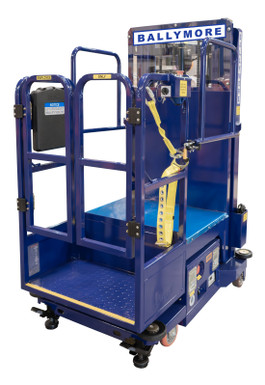
For warehouse stocking and order picking, the best equipment depends on the height, load, aisle layout, and frequency of the work. A Power Stocker is specifically designed for applications where employees need to raise themselves and merchandise to shelf level.
Power Stockers are particularly useful when the alternative is repeatedly climbing a ladder while carrying inventory. The cargo deck allows merchandise to be transported with the worker and positioned at shelf level.
Power Stocker Working Heights and Capacities
- PS-12DRV: 18-foot working height and 650 lb. capacity.
- PS-15DRV: 21-foot working height and 650 lb. capacity.
Both models use a 24-inch by 32-inch cargo deck. They have 12V DC AGM batteries with mounted chargers, recharge from a standard 110V outlet, and provide more than 100 raise and lower cycles between charges under the conditions specified by Ballymore.
The drivable Power Stocker models also use two-hand controls and a key lock. Sensor-equipped versions are available with a sensing system designed to alert the operator to activity below the lift.
Pushable Power Stocker models are also available for facilities that do not require a drivable machine.
What Is the Safest Way to Reach Inventory 14 Feet High?
For inventory around 14 feet high, a lift is often worth considering, particularly when employees repeatedly stock or retrieve products throughout the workday.
A rolling ladder can potentially provide access at this height, but Ballymore's guidance places convenient working height at approximately 5 to 6 feet above the top step or platform. Reaching a 14-foot working height would therefore require a substantially elevated ladder platform, while the employee would still need to climb and handle inventory from the ladder.
A Power Stocker can raise the worker and merchandise together, making it a particularly relevant option for repeated stocking and order picking around this height.
The safest solution is ultimately the one that matches the actual task. Consider the height, load, frequency, duration, floor conditions, surrounding traffic, and operator requirements rather than selecting equipment based on height alone.
What Is the Difference Between Working Height and Platform Height?
Working height and platform height are not the same measurement. Platform height is the height of the platform above the floor. Working height describes the height at which the operator can perform the task and is typically higher than the platform itself.
Ballymore's lift safety guidance generally uses an additional 6 feet above the platform as a way to estimate operator working height. Always select equipment based on the actual height of the work, not just the platform height.
This distinction is especially important when comparing a ladder to a lift. A ladder's top step or platform is not the same as the height at which the worker can comfortably perform a task, just as a lift's platform height is not its working height.
What Safety Factors Matter When Choosing a Ladder or Lift?
The safest access equipment is the equipment that fits the work and is used correctly. Both rolling ladders and lifts have specific operating requirements, so evaluate the complete work environment before making a decision.
Height and Reach
Workers should not have to overreach or stretch beyond a stable working position. If the required reach pushes the ladder beyond its practical working height, consider a lift.
Task Duration
A short inventory check and a 30-minute maintenance task are very different applications. Repeated climbing can make a lift more practical for longer or more frequent work.
Load Handling
Consider what the worker has to carry. A ladder may work well for a label check, but carrying bulky or heavy inventory up and down steps changes the risk profile. A lift can keep the worker and materials together on the platform or cargo deck, depending on the model.
Floor Conditions
Rolling ladders require a level, solid, stable surface. Lifts also have specific surface, slope, and operating requirements that vary by model. Inspect the route and work area before choosing equipment.
Traffic and Clearance
Consider forklifts, pallet jacks, pedestrians, doorways, racks, overhead obstructions, and other equipment. The equipment needs enough room to be positioned and operated without creating additional hazards.
Training and Inspections
Employees need to understand how to properly use the equipment they operate. Rolling ladders require proper positioning, locking, climbing, and descent practices. Lifts require operator training, inspections, and procedures appropriate to the equipment.
For additional guidance, review Ballymore's Ladder Safety and Lift Safety resources.
Rolling Ladder vs. Lift: Advantages and Limitations
Rolling Ladder Advantages
- Simple to position and use.
- No battery or charging requirements.
- Available in multiple materials, heights, widths, and tread configurations.
- Well suited to short-duration access tasks.
- Useful for routine stocking, inventory checks, and light maintenance.
- Can be a practical solution when powered equipment would be excessive for the task.
Rolling Ladder Limitations
- Limited practical working height compared with many lifts.
- Workers must climb and descend the ladder.
- Workers generally carry materials themselves.
- Extended work at height may make a ladder less practical.
- The ladder footprint must be considered in aisles and other traffic areas.
Lift Advantages
- Provides greater working heights on many models.
- Reduces repeated climbing for stocking and picking applications.
- Can raise workers and materials together, depending on the equipment.
- Provides an elevated platform for longer work at height.
- Multiple lift types are available for different applications and environments.
Lift Limitations
- Higher initial equipment cost.
- Requires training and inspections appropriate to the equipment.
- Battery-powered models require charging and maintenance.
- Lift dimensions and operating requirements must be considered when planning aisles, doorways, and storage areas.
- Not every lift is appropriate for every floor, height, load, or work environment.
How Much Does a Rolling Ladder or Lift Cost?
Purchase price is only one part of the decision. Rolling ladders generally have a simpler operating setup, while lifts can involve training, charging, maintenance, inspections, and additional space requirements.
The right comparison is total value for the work being performed. A rolling ladder may be the most economical choice for occasional access, while a lift may provide greater value when employees spend significant time stocking, picking, or performing maintenance at height.
Consider these factors when comparing costs:
- Frequency of use: How often will employees perform the task?
- Labor impact: Will the equipment reduce repeated climbing or repositioning?
- Training: What operator training and procedures are required?
- Maintenance: What inspections, charging, and service will be required?
- Space: Does the equipment fit the aisles, doorways, and storage areas?
- Productivity: Can the equipment reduce unnecessary handling or repeated trips?
The least expensive equipment is not necessarily the best solution. The goal is to select equipment that safely supports the work while fitting the facility's workflow and budget.
How to Choose Between a Rolling Ladder and a Lift
Choose a Rolling Ladder When:
- The task is relatively brief and light.
- The required working height is within the ladder's practical range.
- Workers need frequent access to shelves, bins, or parts.
- The floor is level, stable, and suitable for the ladder.
- The worker does not need to carry heavy or awkward loads while climbing.
- A powered lift would be excessive for the work being performed.
Choose a Lift When:
- The task requires greater working height.
- Workers spend extended periods at elevation.
- Stocking or picking is repeated throughout the shift.
- Workers need to raise materials with them.
- Repeated climbing would slow the job or create unnecessary fatigue.
- The facility can support the lift's operating, training, inspection, and charging requirements.
Many facilities benefit from having both. Rolling ladders can handle everyday access tasks, while lifts can be reserved for higher, longer, heavier, or more repetitive work.
Common Mistakes When Choosing Access Equipment
Buying Based Only on Maximum Height
Maximum height does not tell the whole story. Consider working height, platform height, the task itself, and what the employee needs to carry.
Ignoring the Work Environment
Measure aisles, doorways, overhead clearance, turning areas, and storage locations. Equipment that works perfectly in an open warehouse may not be appropriate for a narrow stockroom.
Ignoring the Load
Consider both the worker and the materials. The equipment must be appropriately rated for the intended load and application.
Treating Training as an Afterthought
Proper equipment selection is only the first step. Employees need to understand how to safely use, inspect, position, and operate the equipment provided to them.
Trying to Use One Solution for Every Task
A facility may not need to choose only one type of access equipment. Rolling ladders, Power Stockers, scissor lifts, vertical mast lifts, merchandise lifts, and maintenance lifts each serve different applications.
Frequently Asked Questions
Is a rolling ladder safer than a lift?
Neither is automatically safer for every application. A rolling ladder can be appropriate for short, light access tasks when properly positioned and used. A lift may be more appropriate for higher, longer, heavier, or repetitive work. The safest choice depends on the specific task and operating environment.
When should I use a lift instead of a ladder?
Consider a lift when workers need greater height, spend significant time at elevation, repeatedly stock or pick products, or need to bring materials and tools with them. The decision should also consider floor conditions, available space, load capacity, training, and operating requirements.
What is better for reaching 14 feet, a ladder or a lift?
A lift is often worth considering for repeated work around 14 feet, especially for warehouse stocking and order picking. A Power Stocker is specifically designed to raise workers and merchandise to shelf level and is available with working heights of 18 and 21 feet on the PS-12DRV and PS-15DRV.
What is the difference between working height and platform height?
Platform height is the height of the platform above the floor. Working height is the height at which the operator can perform the task. Working height is typically higher than platform height because it accounts for the operator's reach.
Are rolling ladders good for warehouse picking?
Rolling ladders can be effective for short-duration warehouse picking and replenishment at moderate heights. If picking is frequent, involves heavier products, or requires employees to work at greater heights for extended periods, a lift such as a Power Stocker may be a better fit.
What is the best lift for warehouse stocking?
There is no single best lift for every warehouse. Power Stockers are specifically designed for stocking and order picking applications, while scissor lifts, vertical mast lifts, merchandise lifts, and maintenance lifts serve other applications. Working height, load, aisle dimensions, and task requirements should guide the selection.
How do I choose the right rolling ladder?
Consider the required working height, ladder material, load capacity, tread type, step width, locking mechanism, floor conditions, aisle space, and ceiling clearance. The right ladder should match both the task and the environment.
What safety factors should I compare when choosing a lift?
Compare working height, load capacity, platform size, lift type, power source, mobility, floor conditions, operator training requirements, and model-specific safety features. Always review the requirements for the specific lift being considered.
Final Takeaway: Rolling Ladder or Lift?
The right choice between a rolling ladder and a lift depends on the work, not simply the height.
Choose a rolling ladder when you need quick, simple access for relatively light and short-duration tasks at moderate heights.
Choose a lift when the work involves greater height, longer work periods, repeated stocking or picking, or the need to raise materials with the worker.
For warehouse and retail stocking applications, a Power Stocker can provide a practical alternative to repeatedly climbing a ladder. For higher work platforms, scissor lifts and vertical mast lifts provide additional options. Merchandise lifts and maintenance lifts address other specialized applications.
When you're not sure which solution fits your facility, start with the task. Identify the required working height, load, frequency, duration, floor conditions, traffic, clearance, and operator requirements. Then choose the equipment that best supports the work.
Explore Ballymore's full range of rolling ladders and lifts, or contact our team for help selecting the right access equipment for your facility.