










Lift Tables: Enhance Industry Safety & Efficiency
What are the benefits of lift tables?
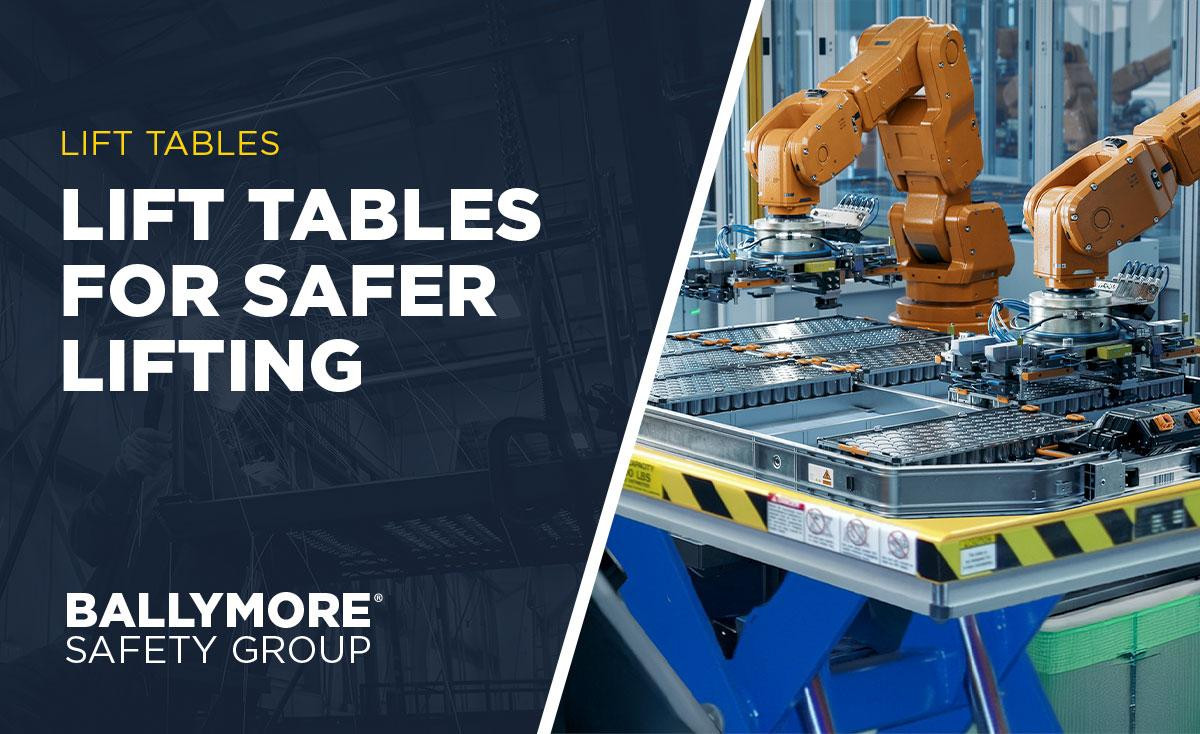
Lift tables raise and lower materials to a comfortable working height, so workers stop bending to the floor, reaching across loads, and lifting by hand. The result is fewer lifting injuries, faster work cycles, and workstations that fit the task instead of the other way around. Ballymore Safety Group makes ergonomic lift tables and pallet positioners through Lift Products, a Ballymore Safety Group company based in Waukesha, Wisconsin.
| Benefit | What it means on the floor |
|---|---|
| Less bending and reaching | Loads sit between knee and shoulder height instead of on the floor |
| Fewer lifting injuries | Workers handle materials in the power zone, where strain on the back and shoulders is lowest |
| Better access through the whole cycle | The platform rises as a pallet empties, so the last layer is as easy to reach as the first |
| Flexible assembly | One adjustable station fits different products, workers, and process heights |
| Smoother material flow | Loads transfer between conveyors, lines, and workstations at matching heights |
How do lift tables reduce lifting injuries?
Lift tables reduce injuries by bringing the load to the worker, which removes the most harmful part of manual handling: lifting from low positions. Musculoskeletal injuries make up roughly a third of workplace injuries, and repeated bending, reaching, and lifting are leading causes. Training helps, but it can't fix a job that requires lifting from the floor all shift.
Ergonomics guidance describes a “power zone” for manual handling: between the knees and the shoulders, and close to the body. Lifting below the knees or above the shoulders is more strenuous, and the NIOSH Revised Lifting Equation treats a load's vertical and horizontal position as factors in its recommended weight limit. A lift table holds the work in the power zone. Adding a turntable top lets workers rotate the pallet instead of reaching across it.
A depalletizing station shows how this works. As cartons come off the top, the platform raises the remaining layers, and a turntable brings the far side of the pallet within reach. The worker stays in a comfortable position from the first carton to the last.
How do you choose the right lift table?
Choose a lift table by matching its capacity, platform size, height range, loading method, and power source to the actual work. Start with the full load, including the pallet, containers, and fixtures, not just the heaviest item. Then confirm workers can load, position, and unload without creating new reaches.
Before asking for a recommendation, document these five things:
- Load: total weight and how it's distributed, including uneven or concentrated loads.
- Platform size: the load's footprint, plus any space needed around it.
- Height range: the lowest loading position and the highest working position.
- Loading method: forklift, pallet jack, conveyor, or hand transfer.
- Operating pattern: how often the height changes, available power, floor space, and whether the table moves between stations.
Watch a complete work cycle before you finalize these. A station that looks comfortable with a full pallet can still force deep bending once only the bottom layer is left.
What is an ergonomic working height?
An ergonomic working height keeps the load between the knees and the shoulders and close to the body. There is no single correct platform height, because it depends on the worker, the task, and how tall the material sits on the platform. A tall container on a raised table can still put its contents too high.
Check a workstation at the start, middle, and end of the loading cycle, and with different workers:
- Torso: look for repeated forward bending as the load gets shorter.
- Shoulders: look for raised arms or reaching above shoulder height.
- Reach: keep frequently handled items close, since height alone doesn't fix a long reach.
A lift table doesn't make an individual carton lighter. If a lift still involves heavy force or an awkward grip, the NIOSH Revised Lifting Equation can help a qualified person assess it, and additional handling equipment or packaging changes may be needed.
Lift table vs. pallet positioner: which do you need?
Choose a lift table when you need a load held at a height you set, like an assembly fixture or a machine-feeding station. Choose a pallet positioner when workers build or break down pallets all day, because it keeps the changing top layer within easy reach. The two overlap, so choose by the task rather than the product name.
| Factor | Lift table | Pallet positioner |
|---|---|---|
| Best for | Positioning parts, containers, fixtures, or pallets at a set height | Repetitive pallet building and breakdown |
| Height adjustment | Set by the operator | Operator-controlled or automatic as the load changes |
| Load access | Depends on the platform configuration | Often includes a turntable to bring the pallet closer |
| Key selection factors | Height range, platform size, load, and process fit | Pallet size, load weight range, and loading method |
If your loads vary a lot in weight, ask how the equipment performs across that range and whether it needs adjustment between loads. When possible, request a demonstration with your own products.
What's the difference between hydraulic and scissor lift tables?
They describe two different parts of the same machine. Hydraulic describes how the table lifts: a pump and cylinders. Scissor describes the folding arms under the platform that support it. Most industrial lift tables are both, with hydraulic cylinders driving scissor arms.
Compare complete configurations rather than feature names. A low-profile table may suit loading with a pallet jack, and a turntable top may improve access around a pallet, but neither replaces checking capacity, loading method, and working height.
When do you need a custom lift table?
You need a custom lift table when a standard model can't meet a documented requirement, like an unusual load footprint, a specific transfer height between lines, or a different control setup. Lift Products designs and builds custom lift tables, and has done so for over 20 years. Its engineers can modify a standard model or design a lift table from the ground up, customizing the platform, controls, portability, and materials.
Give the engineering team drawings, load details, transfer heights, and a description of how operators interact with the table. “Make it more ergonomic” isn't enough to design from, but “workers unload 40-pound cartons from a 48-inch pallet onto a 36-inch conveyor” is.
How do you use a lift table safely?
Use a lift table safely by staying within its rated capacity, keeping hands and feet out of the scissor mechanism, and following the operating manual for your specific model. Better positioning doesn't remove equipment hazards, so build these checks into the routine before the table goes into production:
- Confirm the application: load limits, load distribution, loading method, and a level, solid supporting surface.
- Check operator access: workers should reach the controls and the work without stepping near moving parts.
- Train for normal and abnormal conditions: operation, clearances, safety devices, and how to report damage.
- Plan maintenance: follow the manufacturer's inspection schedule, and always use the maintenance safety bars before working under a raised table. Never rely on hydraulic pressure alone to hold it up.
For more on safe handling, see our Material Handling Safety page.
Start with the task, then choose the equipment
The best reason to invest in a lift table is to change how people handle materials, not just to buy equipment. Document your most demanding workstation, including the load, working height, and loading method, and bring it to an equipment specialist.
Lift Products, a Ballymore Safety Group company, makes ergonomic lift tables, pallet positioners, and custom lifting solutions. Ballymore's Certified Safety Professionals will review your lifting tasks at no cost. Request an ergonomic evaluation, or browse the Lift Tables collection.
Lift table FAQ
What is a lift table used for?
A lift table raises and lowers materials to a comfortable working height for loading, unloading, assembly, and transferring products between process heights. It reduces bending, reaching, and manual lifting.
What height should a lift table be set to?
Set it so the load sits between knee and shoulder height and close to the body. The right setting changes with the worker, the task, and how tall the load is.
Do lift tables reduce workplace injuries?
They can. By keeping loads in the power zone, lift tables reduce the repeated bending and reaching behind many musculoskeletal injuries, which make up roughly a third of workplace injuries.
Is a hydraulic lift table the same as a scissor lift table?
Usually, yes. Hydraulic describes the lifting system and scissor describes the arms that support the platform, and most industrial lift tables use both.
Who makes Ballymore lift tables?
Lift Products, a Ballymore Safety Group company based in Waukesha, Wisconsin, which also builds pallet positioners and custom lift tables.