










How to Reduce Lifting Injuries in a Warehouse

Roto-Max rotating scissor lift tables hold the load at the height the operator sets.
Reducing lifting injuries in a warehouse starts with matching equipment to the movements that create risk: bending, reaching, carrying, and repeatedly raising or lowering loads. Musculoskeletal injuries make up roughly a third of workplace injuries, and training alone can't fix a task that demands excessive force or an awkward posture. This guide explains how to assess lifting tasks, which equipment can help, and how to confirm a change is working.
Ballymore Safety Group offers lift tables, transfer tables, powered pallet jacks, and Power Stocker lifts that can support a better-designed handling process. The products below are starting points for evaluation, not guarantees of injury prevention.
How can a warehouse reduce lifting injuries?
A warehouse can reduce lifting injuries by eliminating unnecessary manual lifts, bringing loads into the power zone between the knees and shoulders, and adding mechanical assistance where a lift can't be avoided. Training supports these changes, but it shouldn't replace redesigning a task that requires excessive force or awkward movement.
NIOSH's hierarchy of controls puts elimination, substitution, and engineering controls ahead of administrative controls and protective equipment, because they control exposures without significant human interaction. For lifting, that means changing the task or the equipment before relying on technique alone.
The problem is broader than heavy boxes. OSHA's warehousing guidance lists lifting and lowering heavy items, bending, reaching overhead, pushing and pulling heavy loads, awkward postures, and repetitive tasks as ergonomic risk factors that raise the risk of musculoskeletal disorders, such as muscle strains and lower back and shoulder injuries. Prevention has to consider the complete handling cycle, not just the weight printed on a carton.
Start by reviewing injury and near-miss records and asking workers which tasks in receiving, replenishment, picking, and packing are hardest. Then observe the actual work, not a demonstration of how the process is supposed to run. Use what you find to set priorities:
- Repeated floor-level lifts: Raise the load or change how it is presented.
- Reaching across pallets: Improve access to the product instead of asking workers to stretch farther.
- Carrying between stations: Consider equipment that supports horizontal movement.
- High-shelf handling: Review both access and the method used to transfer merchandise.
- Frequent awkward lifts: Evaluate the combined effect of repetition, posture, and load weight.
What is the NIOSH lifting equation?
The Revised NIOSH lifting equation is a risk assessment tool for two-handed manual lifting. It uses task conditions such as load weight, hand position, vertical travel, twisting, lifting frequency, duration, and grip to calculate a Recommended Weight Limit, then compares the actual load to that limit as a Lifting Index.
NIOSH set a Lifting Index of 1.0 as the benchmark, and a result above 1.0 indicates the task may put some workers at increased risk. A Composite Lifting Index covers jobs with multiple lifting tasks. The result should inform a broader assessment, not serve as a promise that nobody will be injured.
Consider a packing station where workers repeatedly move cartons from a low pallet onto a bench. A good assessment captures the changing pickup height as the pallet empties, not just the easiest lift from the top layer. After installing a suitable lift table, repeat the assessment to see whether the measured conditions improved.
Know the tool's limits. The equation doesn't cover one-handed lifting, unstable loads, seated or kneeling lifts, or tasks in restricted spaces, and it doesn't assess lifting while carrying, pushing, or pulling. Replacing a lift with a slide doesn't remove the need to assess the remaining effort.
What is the power zone for lifting?
The power zone is the range between the knees and the shoulders, close to the body, where manual handling is least strenuous. Lifting below the knees, above the shoulders, or far from the body is more strenuous. Keeping loads in this zone is a core goal of ergonomic workstation design.
A lift table holds work in the power zone as loads change height. Browse our lift tables to see the options.
What equipment reduces lifting injuries in a warehouse?
The right equipment depends on what must change: load height, access, transfer method, or travel. Lift tables and positioners raise loads into the power zone, transfer tables turn lifts into slides, powered pallet jacks move pallets, and Power Stocker lifts bring merchandise to shelf level. Start with the task assessment, not capacity alone.
| Lifting problem | Equipment type | Ballymore Safety Group option |
|---|---|---|
| Bending to a low pallet or reaching across it | Lift table with a rotating top |  Roto-Max rotating lift tables |
| Lifting merchandise on and off shelves | Ball conveyor transfer table | |
| Raising merchandise to shelf level | Power Stocker lift |  PS-15DRV |
| Moving full pallets | Powered pallet jack |  BALLYPAL45N-27 |
| A task no standard model fits | Custom lift table | Lift Products custom lift tables |


Rotating lift tables for pallet loading and unloading

The Roto-Max rotating scissor lift from Lift Products, a Ballymore Safety Group company, is an electric hydraulic work positioner with a 43-inch rotating top. The height stays where the operator sets it, whether the load is one pound or the table's full capacity, and it is available in 2,500, 3,000, and 3,500 lb. models. It lowers to just 6-1/2 inches, so the operator has easy access to the top layer of product, and raises to 32-1/2 inches plus pallet height. The top rotates easily, giving access to product without stretching or walking around the pallet.
A depalletizing station is a natural fit. As each layer comes off, raising the remaining product and rotating the pallet changes both pickup height and access. During a trial, check that operators actually use those adjustments through the whole task instead of leaving the table at one setting.
Lucy transfer tables for sliding merchandise
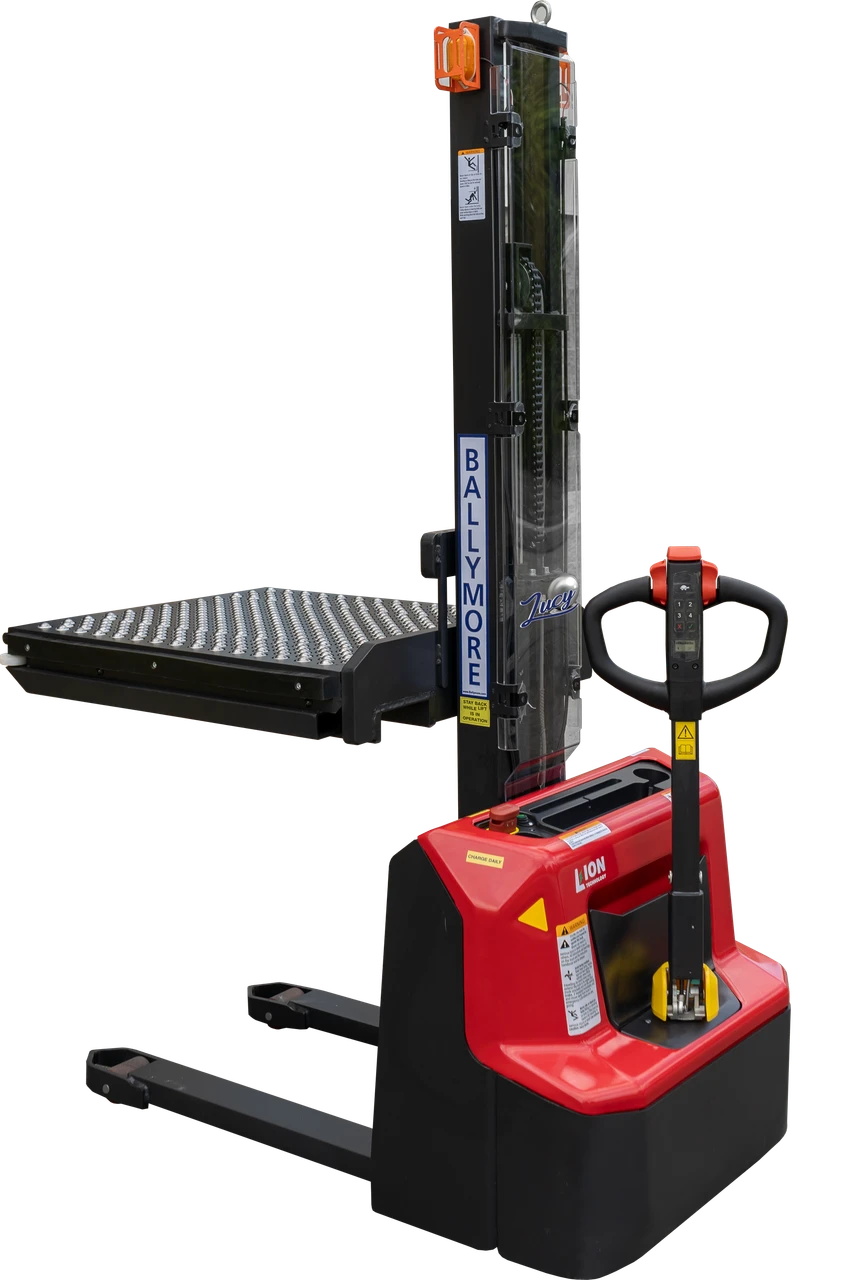
Our Lucy ball conveyor transfer table has a powered platform with adjustable height from 6-1/2" to 72" and a 500 lb. capacity. It is designed to turn a lifting or lowering task into a lower-risk push or pull: roll merchandise onto the table, rotate it, and slide it onto or off a shelf. The multi-directional balls retract automatically when the table is lowered to provide a secure surface for transport, and they can be raised or lowered independently of the table height control. Key control and an emergency stop button come standard.
The pushable BALLYPAL-STK48BC offers the same 500 lb. capacity and the same automatically retracting balls. Before adopting either table, confirm that the package base, shelf arrangement, transfer gap, and load stability suit the equipment. The remaining push or pull still needs to be assessed.
Power Stocker lifts for elevated replenishment

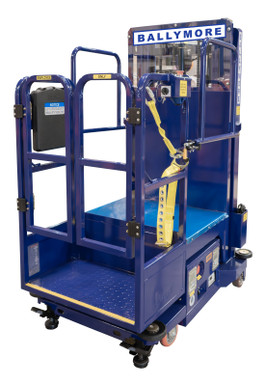
The PS-15DRV Power Stocker raises merchandise to shelf level so it can be slid onto or off shelves, minimizing lifting. It has a 21' working height, a 650 lb. weight capacity, and a 24" x 32" cargo deck, with two-hand controls and a key lock to prevent unauthorized use. Review the entire transfer before choosing a stocker lift. Bringing merchandise to shelf level only helps when workers can finish the transfer without another awkward lift or an unsupported reach. See all Power Stocker lifts.
Powered pallet jacks for pallet transport

The BALLYPAL45N-27 supports travel, lifting, and lowering with a 4,500 lb. capacity.
View BALLYPAL45N-27The BALLYPAL45N-27 is a self-propelled electric pallet jack with a 4,500 lb. capacity and a maintenance-free lithium battery. It supports travel, lifting, and lowering, and includes pin control for authorized use, emergency reverse and horn buttons, a battery discharge indicator, and on-board diagnostics. The tiller can also be operated in the vertical position for work in confined areas. Browse our pallet jacks.
A pallet jack solves a different problem than a lift table. Moving a pallet doesn't correct an awkward case-picking height. Evaluate the travel route as carefully as the load, including floor condition, congestion, visibility, clearance, and pedestrian traffic. Under OSHA 29 CFR 1910.178, operators of powered equipment such as electric pallet jacks need formal training and authorization before use.
How do you choose equipment for the complete handling cycle?
Choose equipment by documenting the full handling cycle, not just the load's weight. Capacity is a necessary check, but a table that supports the weight can still be a poor fit if its surface forces excessive reaching or its footprint blocks access. Prepare a short application brief before requesting recommendations:
- Load: weight, dimensions, packaging, stability, and support requirements.
- Pickup and destination: measure both surfaces and describe how the load crosses between them.
- Handling pattern: frequency, duration, product variation, and changes as pallets empty.
- Space: aisles, turning areas, nearby equipment, and worker access.
- Environment and utilities: floor conditions, power availability, and special material requirements.
- Controls: where the operator stands and how adjustments will be made.
Send that brief to Ballymore Safety Group, with photographs or a workflow sketch if useful. If no standard model fits, our custom lift tables can be designed around your application.
How do you prevent back injuries in a warehouse?
Prevent back injuries by redesigning the highest-risk tasks first, then supporting that work with safe lifting technique and training. Technique matters wherever manual handling continues: test the load before lifting, keep it close to the body, turn with the feet instead of twisting, use the legs, and get help when a load is too heavy to manage safely. These habits support back injury prevention, but they don't make an unsuitable task acceptable.
Make ergonomic lifting instruction specific to the workstation. Show workers when to adjust the lift table, how to position a transfer table, and when to stop and ask for help. NIOSH's guide to ergonomics programs emphasizes management commitment, worker involvement, and training that builds the ability of both workers and managers to recognize and solve musculoskeletal problems. Include a way for workers to report hazards and early symptoms so concerns reach the people who can fix the task.
How do you know the changes are working?
You know a handling change is working by checking whether it reduces the targeted exposure without creating new problems. Compare the task before and after the change, gather worker feedback, and review ergonomic conditions and operational results together. Trial new equipment at one workstation first, and adjust the setup before rolling it out more widely.
- Has the intended motion changed? Compare bending, reaching, unsupported lifting, and handling frequency.
- Is the equipment used consistently? Observe representative work, not only the first demonstration.
- Have new demands appeared? Review pushing effort, access restrictions, and awkward transfer positions.
- What do workers report? Collect feedback on discomfort, difficult adjustments, and remaining handling problems.
- Do broader results support the change? Review job analyses, symptom surveys, injury records, quality, and productivity together.
Don't treat a short injury-free period as proof of success. Keep reviewing the process when products, work rates, layouts, or staffing change.
Build prevention into everyday material handling
An effective approach to manual material handling combines task assessment, the right equipment, worker involvement, and follow-up. The goal isn't only to teach people to lift better. It is to reduce the need for difficult lifts in the first place.
Start with one clearly defined problem and bring it to our team. Ballymore's Certified Safety Professionals will evaluate your lifting tasks at no cost: send a video of the task, and they will analyze it using REBA and the NIOSH Lifting Index. Request a free ergonomic evaluation, learn more on our Material Handling Safety page, or request a quote.
Warehouse lifting injury FAQ
How do you reduce lifting injuries in a warehouse?
Eliminate unnecessary manual lifts, bring loads into the power zone between the knees and shoulders, and add mechanical assistance such as lift tables or transfer tables. Training supports these changes but can't fix a task that requires excessive force or awkward posture.
What causes lifting injuries in warehouses?
OSHA lists lifting and lowering heavy items, bending, reaching overhead, pushing and pulling heavy loads, awkward postures, and repetitive tasks as ergonomic risk factors for musculoskeletal disorders.
What is the power zone for lifting?
The power zone is the range between the knees and shoulders, close to the body, where manual handling is least strenuous.
What is the NIOSH lifting equation?
It is a risk assessment tool for two-handed manual lifting that calculates a Recommended Weight Limit and a Lifting Index from conditions such as load weight, hand position, vertical travel, twisting, frequency, and grip.
What equipment reduces lifting injuries?
Lift tables and positioners, ball conveyor transfer tables, Power Stocker lifts, and powered pallet jacks each address a different part of the handling cycle. Choose by assessing the task first.