










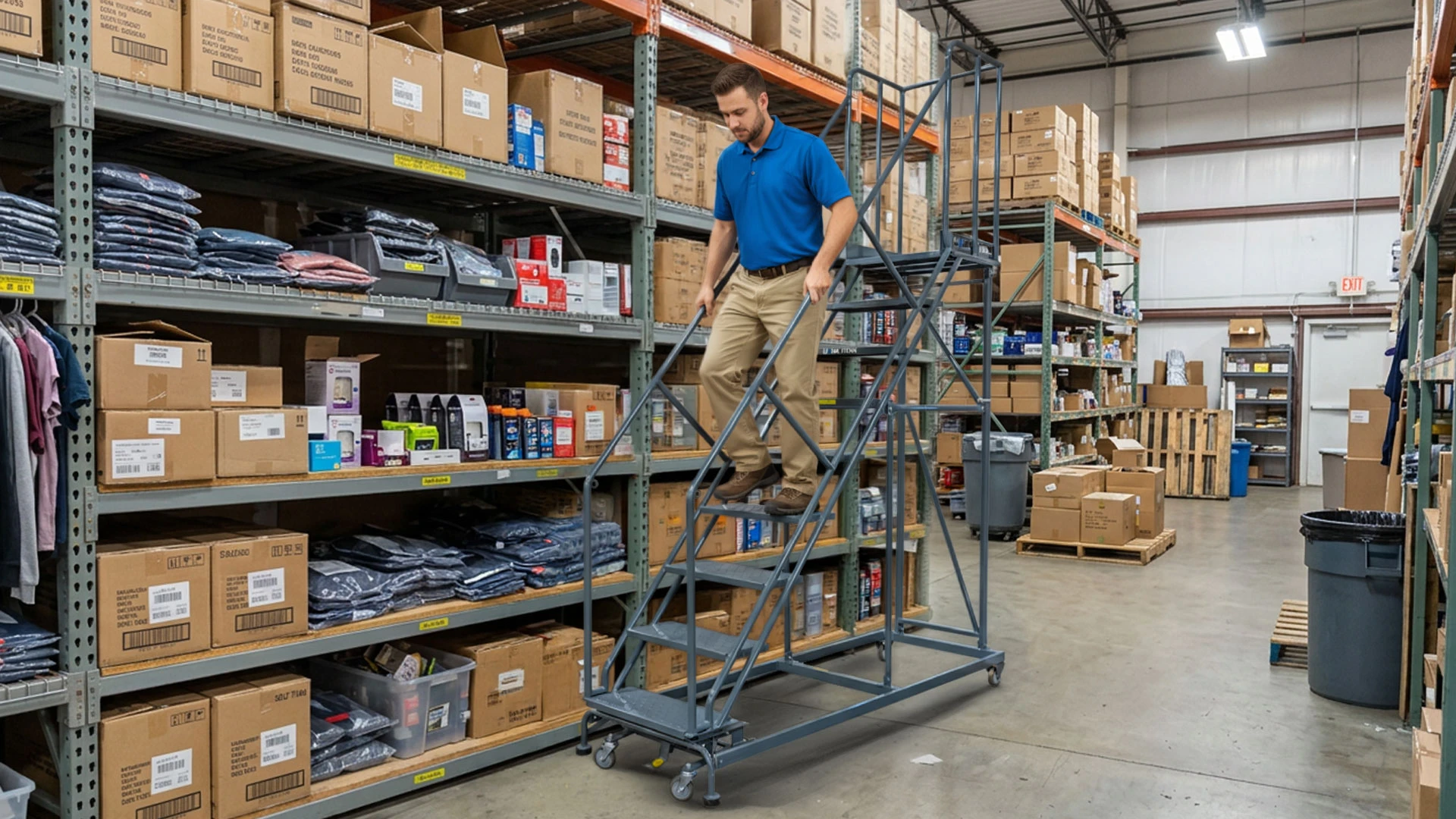
How to Choose the Right Rolling Ladder: An 8-Step Buying Guide
The right rolling ladder depends on material, tread type, platform height, and how much space you have to work with. This guide walks through each factor so you can match a rolling ladder to your facility, whether that's a warehouse, retail backroom, or manufacturing floor.
Choosing the right ladder means looking at several factors together, not just one. Material is a key part of safe vertical access, especially for a rolling ladder used in busy spaces where it will see daily wear. Different materials offer different levels of strength, durability, and corrosion resistance, so the right choice depends on your environment as much as your budget.
Step 1. Consider the Ladder Material
- Powder-coated steel ladders are corrosion-resistant and work well in dry areas. Load capacities range from 450 to 800 lbs. They have replaceable parts.
- Aluminum ladders are lightweight, suitable for indoor and outdoor use, but not around electricity. They have a 350 lbs. load capacity.
- Hybrid ladders combine aluminum and powder-coated steel for lightweight maneuverability and strength, with a 450 lbs. weight capacity.
- Stainless steel ladders are durable and corrosion-resistant, ideal for various environments, including food and marine. They're easy to clean and maintain, with replaceable parts, and carry a 450 lbs. weight capacity.
Step 2. Tread Types
- Perforated Step Tread: Economical and provides excellent slip resistance. Used extensively in retail and storeroom applications. Available in Steel, Aluminum (Tri-Arc and Hybrid Ladders), and Stainless Steel (Ballymore).
- Expanded Metal Step Tread: This aggressive tread is ideal for warehouse or retail applications. This design is self-cleaning, allowing foot debris to fall through the tread. Available in Steel Only (Ballymore).
- Serrated Grating Tread: The most aggressive tread, designed for the shop floor or any industrial application where maximum slip resistance is required. Available in Steel, Aluminum (Tri-Arc), and Stainless Steel (Ballymore).
- Abrasive Mat Tread: A solid steel step with a non-skid abrasive mat. Ideal for retail applications. Available in Steel Only.
- Ribbed Tread: Economical aluminum tread. Available in Aluminum Only.
Step 3. Specialty and Custom Ladders
We offer specialty solutions to meet your specific requirements. Standard options include deep top steps, all-directional capability, Employee Only signage, exits on the ladder (front or rear), and custom colors (Ballymore only). If these options don't align with your specific needs, contact us for help with a custom order.
Step 4. Platform Height
Determine both your working and platform height dimensions so you're able to figure the number of steps you'll need. Select platform height based on the operations to be performed or the weight and bulk of the object to be carried. The maximum convenient working height is generally 5 to 6 feet above the top step or platform.
Step 5. Ceiling Height
Also consider the ceiling height. Minimum ceiling height should be 6 to 7 feet above the top step or platform.
Step 6. Step Width
This depends on your surroundings. Is this ladder used outdoors? In a warehouse? In a manufacturing facility? Standard widths are 16", 24", and 36". In larger ladders, choose a wide ladder over a narrow one if space permits. For very bulky loads, consider a stairway slope ladder and/or deeper top steps.
Step 7. Aisle Space and Other Obstructions
Ask yourself: will people pass the ladder in an aisle? Where will it be stored when not in use, and is there enough space to accommodate it? Always consider limitations on ladder dimensions imposed by doorways, overhead obstructions, corners to be turned, and so on.
Step 8. Locking Mechanisms
- Lift Assist Lockstep (Patented Ballymore only): The safest and most durable lock step on the market today. Apply weight to the steps and the ladder automatically drops the front feet to the ground, securing the ladder for safe climbing.
- Weight Actuated Lockstep (Patented Ballymore only): This patented, state-of-the-art lock step automatically actuates when weight is applied to the stair section.
- Standard Lockstep: Ideal for applications over 5 steps. These ladders are raised into the rolling position when the lift bar is depressed. To release the lock step, step on the release bar in front of the first step.
- Spring Loaded Casters: Ideal for shorter ladders, 5 steps and below. On this style ladder, the wheels retract under the user's weight, securing the ladder to the floor.
Frequently Asked Questions
What is the safest ladder locking mechanism?
The Lift Assist Lockstep, patented by Ballymore, is the safest and most durable lock step currently on the market. Weight on the steps automatically drops the front feet to the ground, securing the ladder before anyone climbs.
How much weight can a rolling ladder hold?
Load capacity depends on material. Aluminum ladders hold up to 350 lbs., hybrid and stainless steel ladders hold up to 450 lbs., and powder-coated steel ladders range from 450 to 800 lbs.
What ceiling height do I need for a rolling ladder?
Minimum ceiling height should be 6 to 7 feet above the top step or platform to allow safe clearance while climbing.
What tread type offers the most slip resistance?
Serrated grating tread is the most aggressive option, built for shop floors and other industrial settings where maximum slip resistance is a priority.
What's the difference between a standard lockstep and spring loaded casters?
Standard lockstep suits ladders over 5 steps and raises the ladder into rolling position when the lift bar is depressed. Spring loaded casters suit shorter ladders of 5 steps or fewer, retracting under the user's weight to secure the ladder.